Recruiter radar
A recruiting radar for the San Francisco Bay Area that ranks eight employers by how bad and how recent their last 90 days were, and lists the frontend engineers at each one with…
- Built in
- 19 min
- Capabilities
- 6
- Live API calls
- 24

The prompt
Paste it into any coding agent with the Trayo MCP connected.
- + any MCP client


Use Trayo to build a recruiting radar. I name a city and the kind of role I am hiring; you find companies in that area showing signs of trouble — layoffs, restructuring, an acquisition, bad news — in the last 90 days.

For each company, surface the people there who do the job I am hiring for, with their title and tenure. Rank companies by how strong and how recent the signal is. Present it as a list of companies with their people underneath and the triggering event shown as proof. Handle this with some care in the copy: these are people having a bad quarter, not leads.
What this app asked Trayo for
Every name, number and email on the page came back from one of these. None of it was typed in.
- Reads your workspace
What you sell, who you sell to, and the buyer personas already saved in Trayo.
- Finds companies
Surfaces accounts that match your ICP, plus lookalikes of the ones already working.
- Finds the right people
Named stakeholders at an account, matched to the buying roles you care about.
- Builds your account list
Imports, updates and organises accounts so the work survives the session.
- Watches for buying signals
Standing watches for job changes, funding and the other moments worth a reply.
- Reads social activity
Posts and the people engaging with them, for plays that start from a conversation.
Take the tour
The same run as the video above, one stop at a time.
- 01
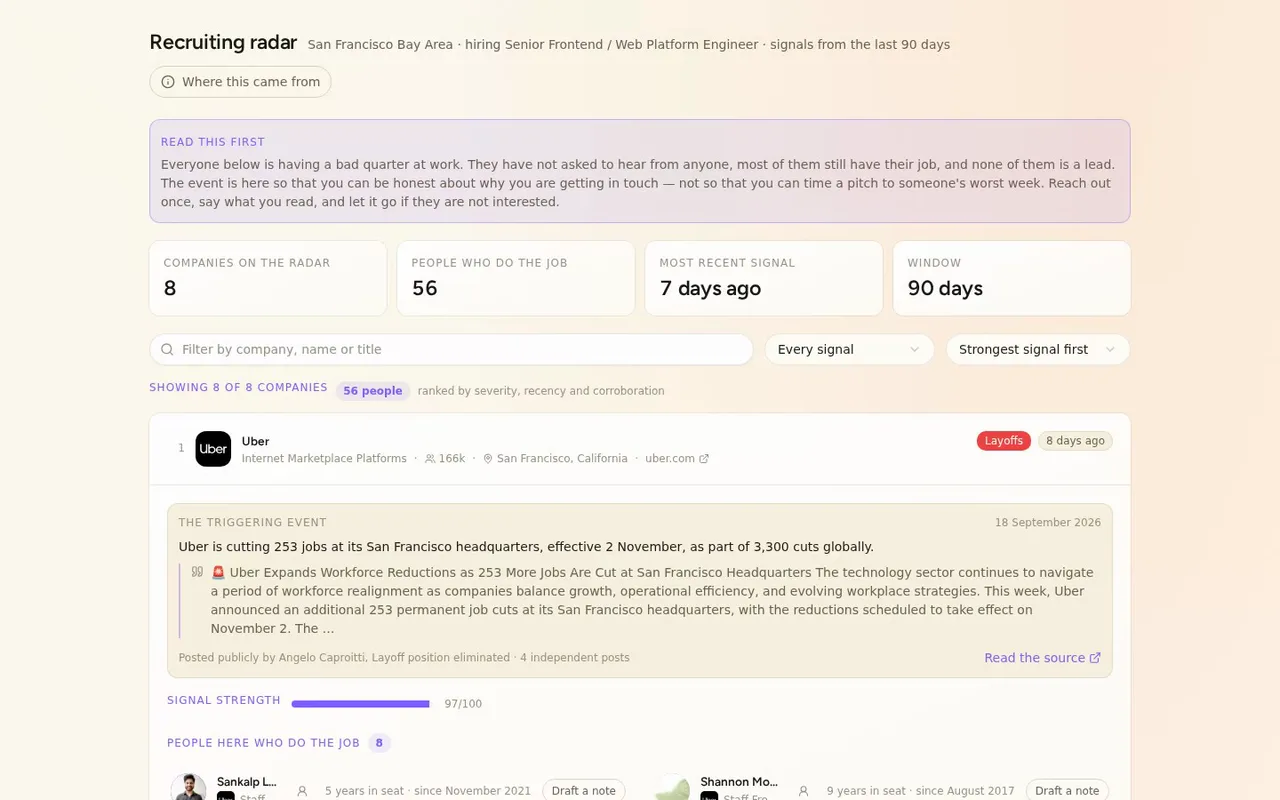
This is the recruiting radar for the Vercel team. It ranks Bay Area employers by how rough their last ninety days were, and lists the frontend engineers at each. When someone's company has a visibly bad quarter, you know who to talk to first.
- 02
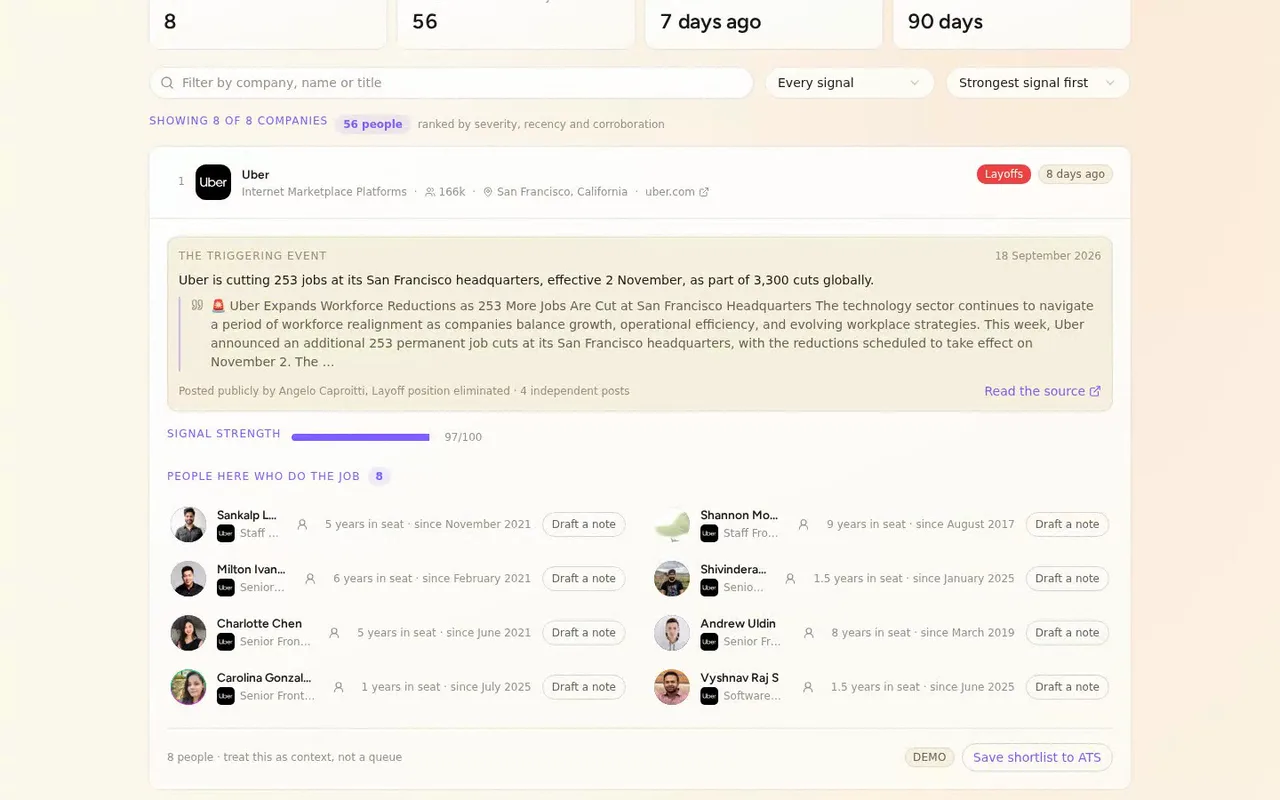
It's built for any search we run, and here it's eight employers, ranked by severity, recency and how many sources describe the event.
- 03
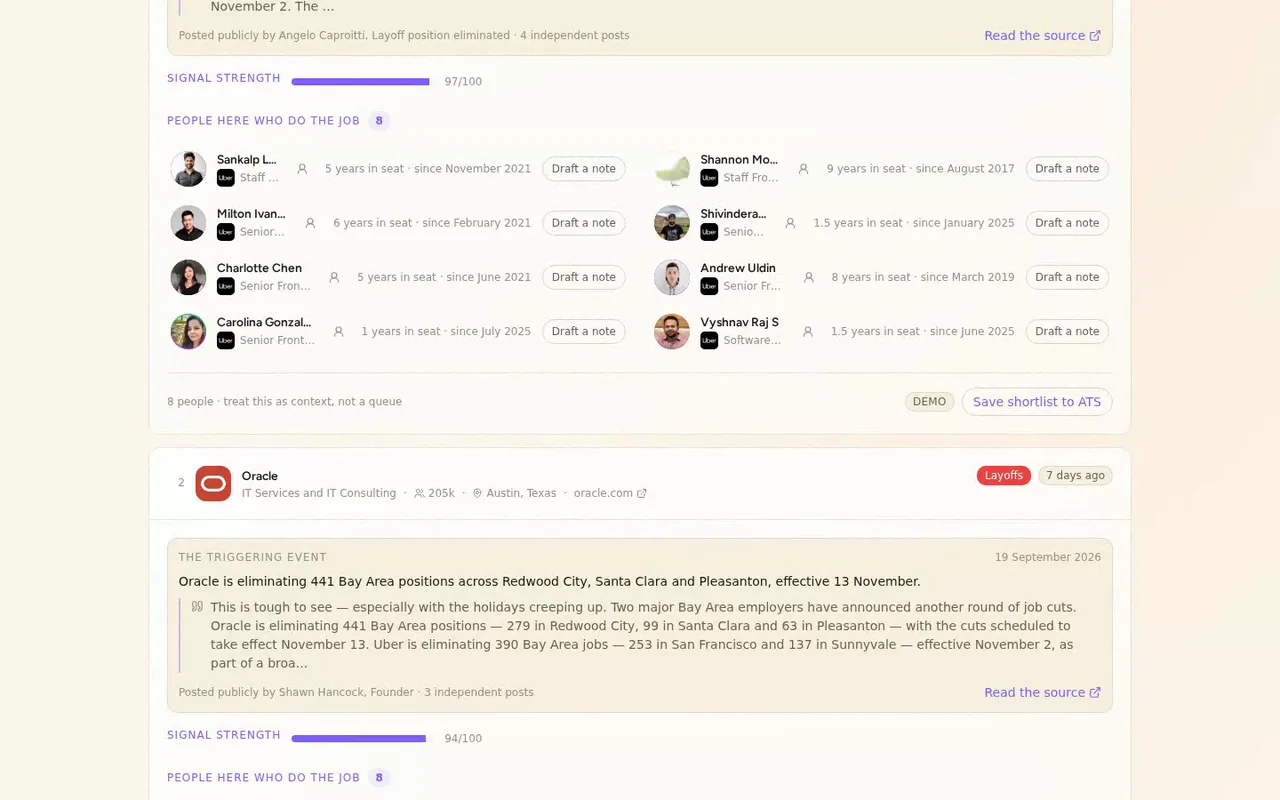
A banner up top says these are people having a bad quarter, not leads. The copy stays honest about that.
- 04
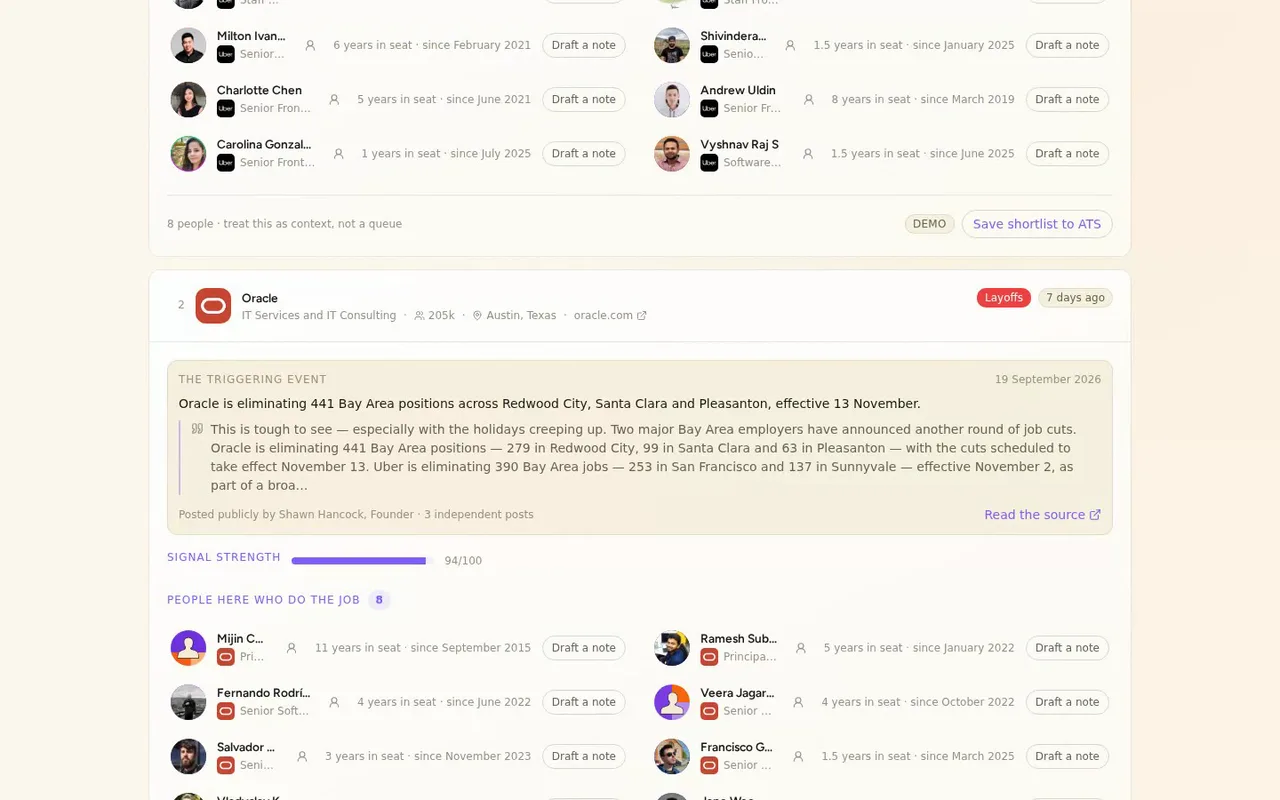
Tenure is computed from the dated career history that Trayo's person research returns, for all but one of them.
- 05
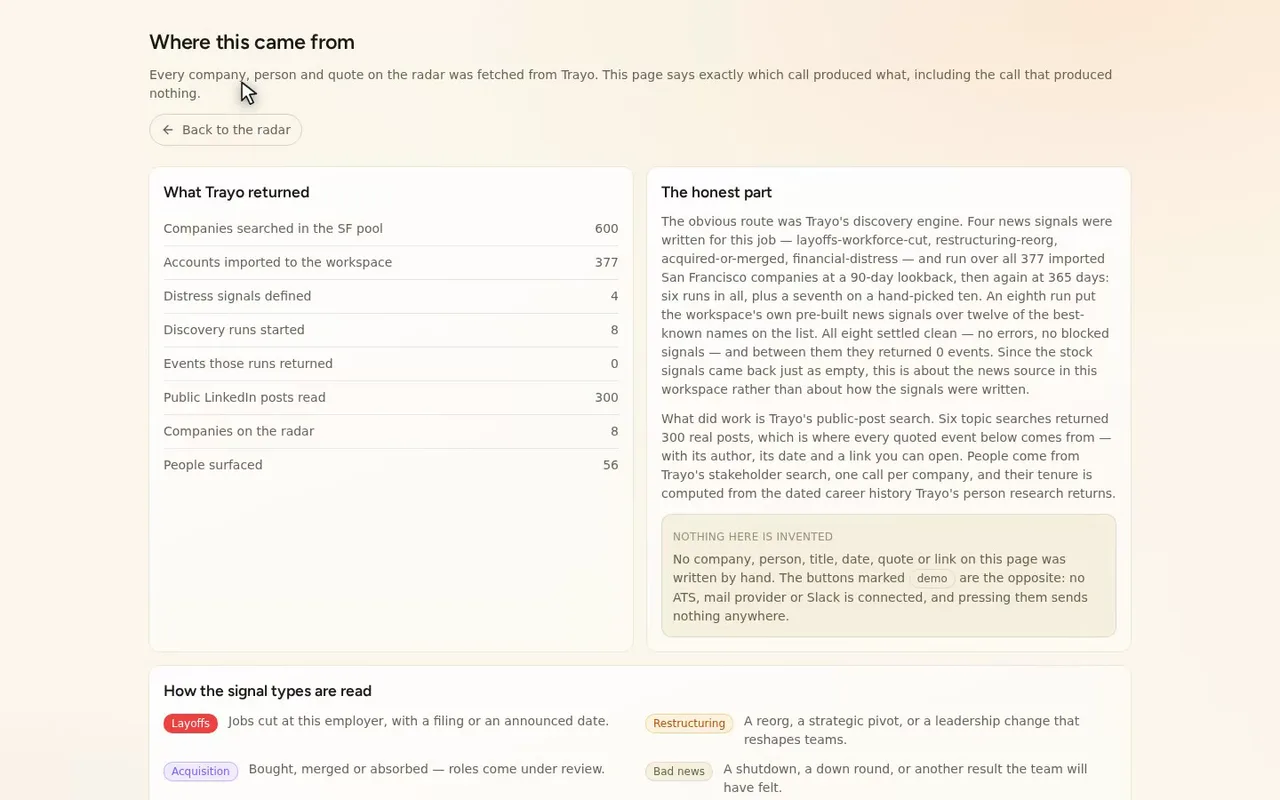
The where-this-came-from page shows the build: six topic searches returned three hundred real LinkedIn posts.
- 06
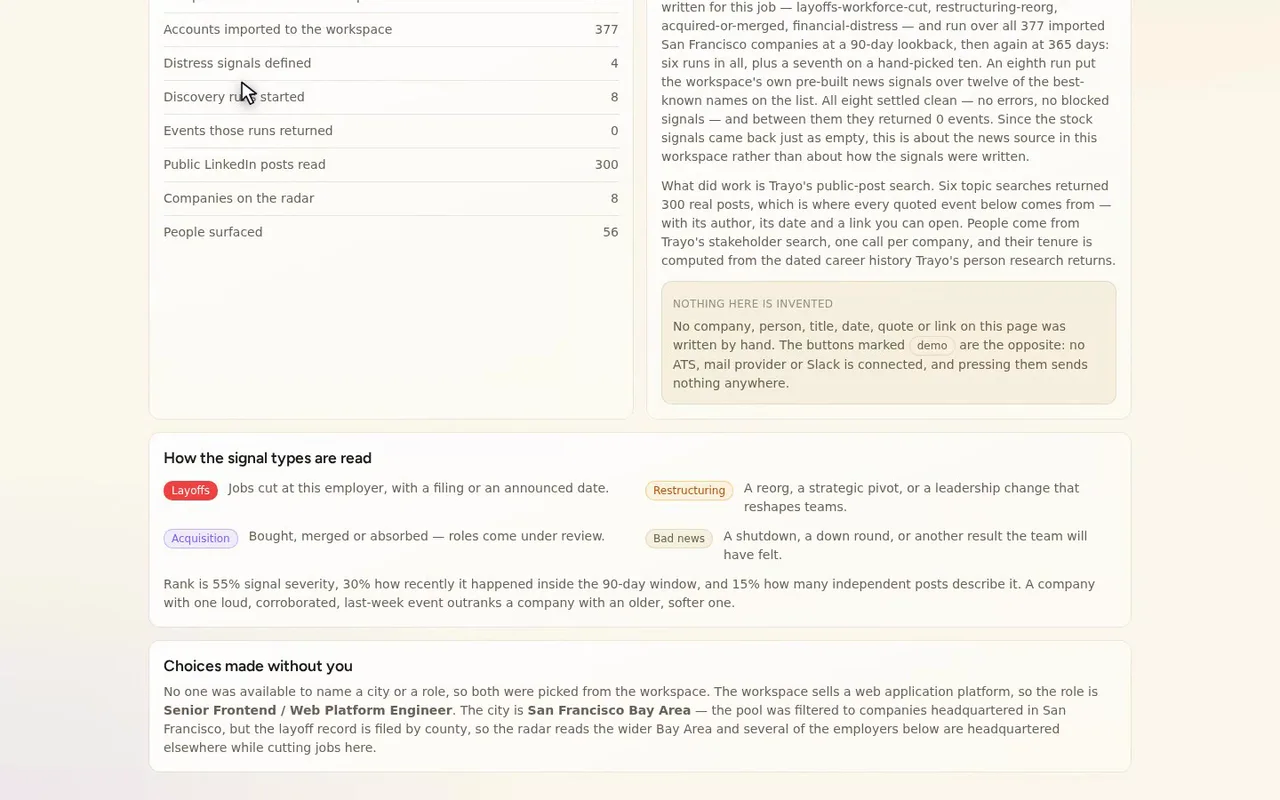
Every quote, date, author and link on the radar comes from one of those posts.
How it was built
The data behind each screen, and what's faked for the demo.
If you’re recruiting senior frontend or web platform engineers in the Bay Area, this is for the week after a company has a rough quarter and you want to know who is sitting inside it. You get eight employers ranked by how severe the event was, how recent it was and how many independent sources describe it. Under each one are the frontend engineers there, with their real title and how long they’ve been in the seat. Above them is the triggering public post, shown verbatim with its date, author and a link. A banner at the top says these are people having a bad quarter, not leads, and the outreach draft refers to the public event as public rather than implying you know anything more.
What it replaces is the tab-switching: a layoffs tracker in one window, LinkedIn in another, a spreadsheet of names that was stale the day you made it, and a manual pass to work out who is actually an engineer and how long they’ve been there. Here the event, the ranking and the people sit on one page, and every quote traces back to a source you can open.
The news path was empty, so I rebuilt around public posts. A filtered company search returned 600 San Francisco companies and I imported 377 as accounts. I defined four distress signals (layoffs-workforce-cut, restructuring-reorg, acquired-or-merged, financial-distress) and ran eight discovery runs across all 377 accounts at both 90- and 365-day lookbacks. They settled clean, with no errors and no blocked signals, and returned zero events. The workspace’s own pre-built news signals returned zero on the same accounts too, so the news path is genuinely empty here rather than misconfigured. I switched to public-post search: six topic searches returned 300 LinkedIn posts, and every quote, date, author and link on the page comes from one of them. For people I ran the stakeholder search once per company, which gave back 56 engineers with real names, titles, photos and profile links. Person research returned dated career histories for all but one of them, and I computed tenure from those. The company pool was filtered to San Francisco headquarters, but layoff filings are made by county, so the radar reads the wider Bay Area. Several employers on it are headquartered elsewhere and cutting jobs here.
Two things are not what they look like. Pulley is on the radar with no people under it. Trayo resolved the right company, the cap-table startup and not the permitting company of the same name that a search by name returned first. But the stakeholder search found no one publicly holding a frontend title at a 105-person company that is winding down. The card says that instead of hiding the row. The other gap is the two buttons that need an outside system, “Save shortlist to ATS” and “Open in mail client”. They are stubs with a demo tag. Pressing either shows exactly what would have been sent and confirms that nothing left the browser, because no ATS, mail provider or Slack is connected to this workspace.