The exec dinner builder
A twelve-seat executive dinner planner for Chicago data and AI leaders: a guest list where every invitee carries a dated reason, a round-table seating chart that argues each of…
- Built in
- 15 min
- Capabilities
- 8
- Live API calls
- 46

The prompt
Paste it into any coding agent with the Trayo MCP connected.
- + any MCP client


Use Trayo to build an executive dinner planner. I pick a city and a persona; you build me a twelve-seat guest list.

For each guest: face, title, company, and the specific reason they belong at this table — a signal at their company, a recent move, something they posted. Balance the room so it is not twelve people from one industry. Then lay out a seating chart that puts people next to someone they would genuinely want to talk to, and say why for each pairing. Contact details behind a button, not on the page.
What this app asked Trayo for
Every name, number and email on the page came back from one of these. None of it was typed in.
- Reads your workspace
What you sell, who you sell to, and the buyer personas already saved in Trayo.
- Finds companies
Surfaces accounts that match your ICP, plus lookalikes of the ones already working.
- Researches an account
A live snapshot per company — size, stack, why-now signals and why it fits.
- Finds the right people
Named stakeholders at an account, matched to the buying roles you care about.
- Gets verified emails
Work addresses with a confidence signal, so a bad match is visible rather than sent.
- Builds your account list
Imports, updates and organises accounts so the work survives the session.
- Watches for buying signals
Standing watches for job changes, funding and the other moments worth a reply.
- Reads social activity
Posts and the people engaging with them, for plays that start from a conversation.
Take the tour
The same run as the video above, one stop at a time.
- 01
This app runs on Trayo, an AI go-to-market data platform.
- 02
Trayo found 60 Chicago companies, kept 12, one per industry.
- 03
Then it scored stakeholders and researched each account and person.
- 04
It even caught a job move that put a guest on the list.
- 05
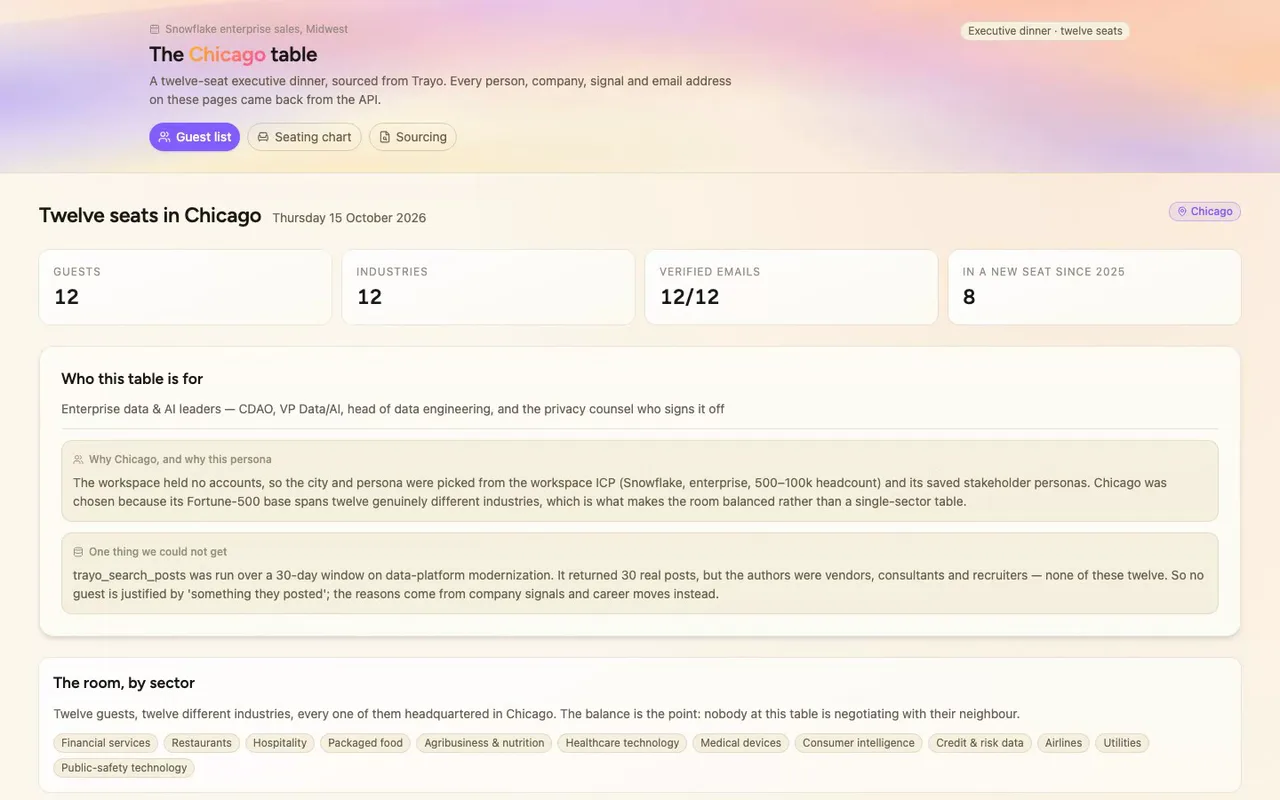
The result: a twelve-seat executive dinner planner.
- 06
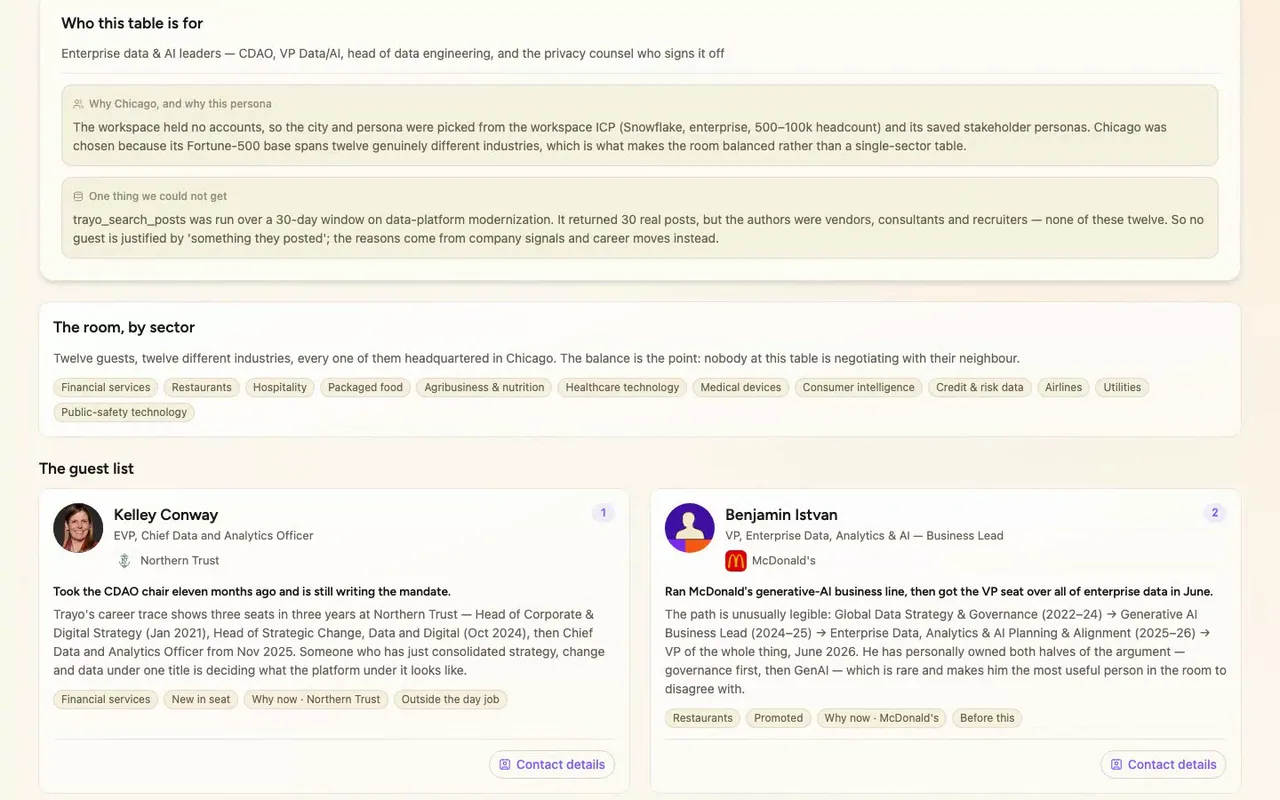
Twelve leaders, twelve industries, all Chicago-based.
How it was built
The data behind each screen, and what's faked for the demo.
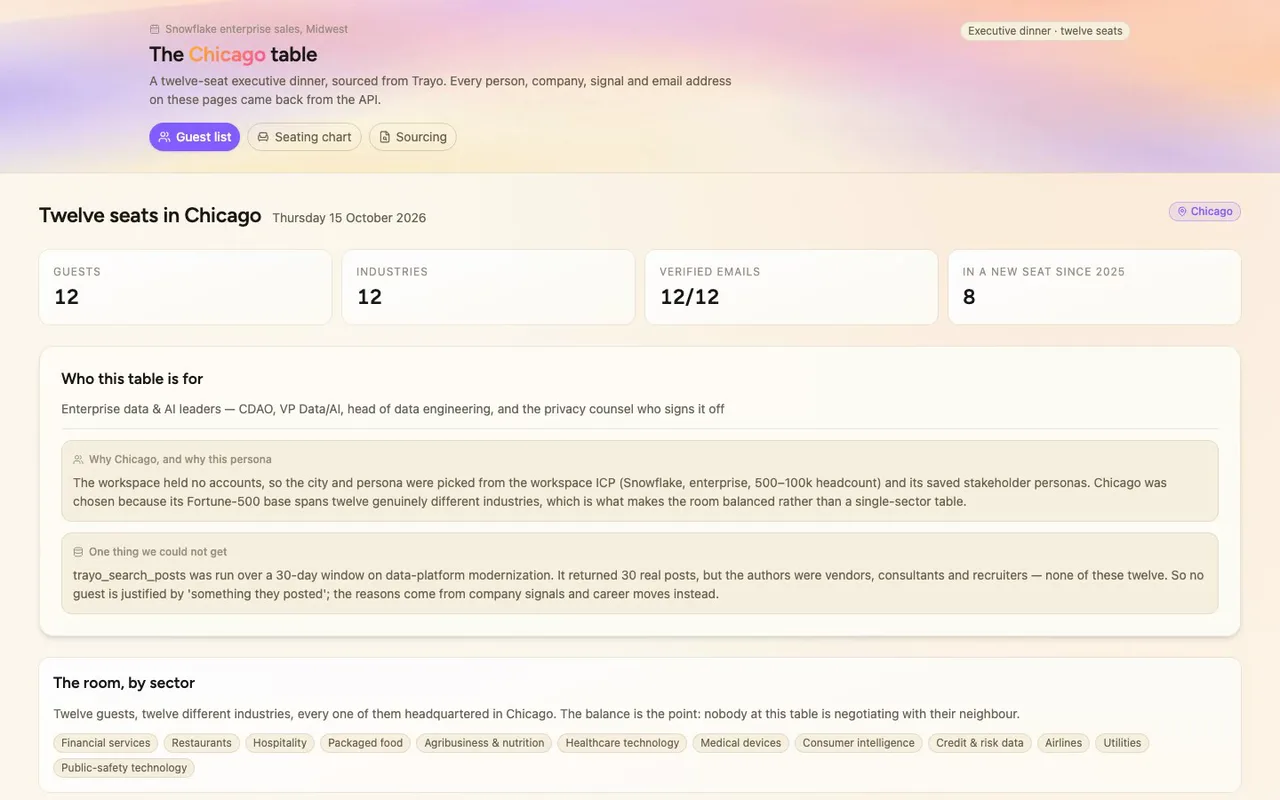
This is for a salesperson planning a small executive dinner, the week they need to fill twelve seats and can’t afford a table of strangers who have nothing to say to each other. They pick a city and a persona, and get a guest list of twelve: each guest has a face, title, company logo, a one-line reason they belong, and an expandable panel with the evidence. A second page shows a round-table seating chart with a written justification for every one of the twelve adjacencies. Contact details stay off the list; each guest has a Contact details button that opens a dialog.
It replaces the stitching-together a host normally does by hand: a company list in one tab, LinkedIn in another, a news search per account, a spreadsheet of names, then a guess about who should sit next to whom. Here every invitee carries a dated reason, so the host can say why each person is there. The seating chart gives the host a reason for every pairing, so they can explain to anyone why they are sitting where they are. The room is also balanced across industries rather than twelve people from one sector.
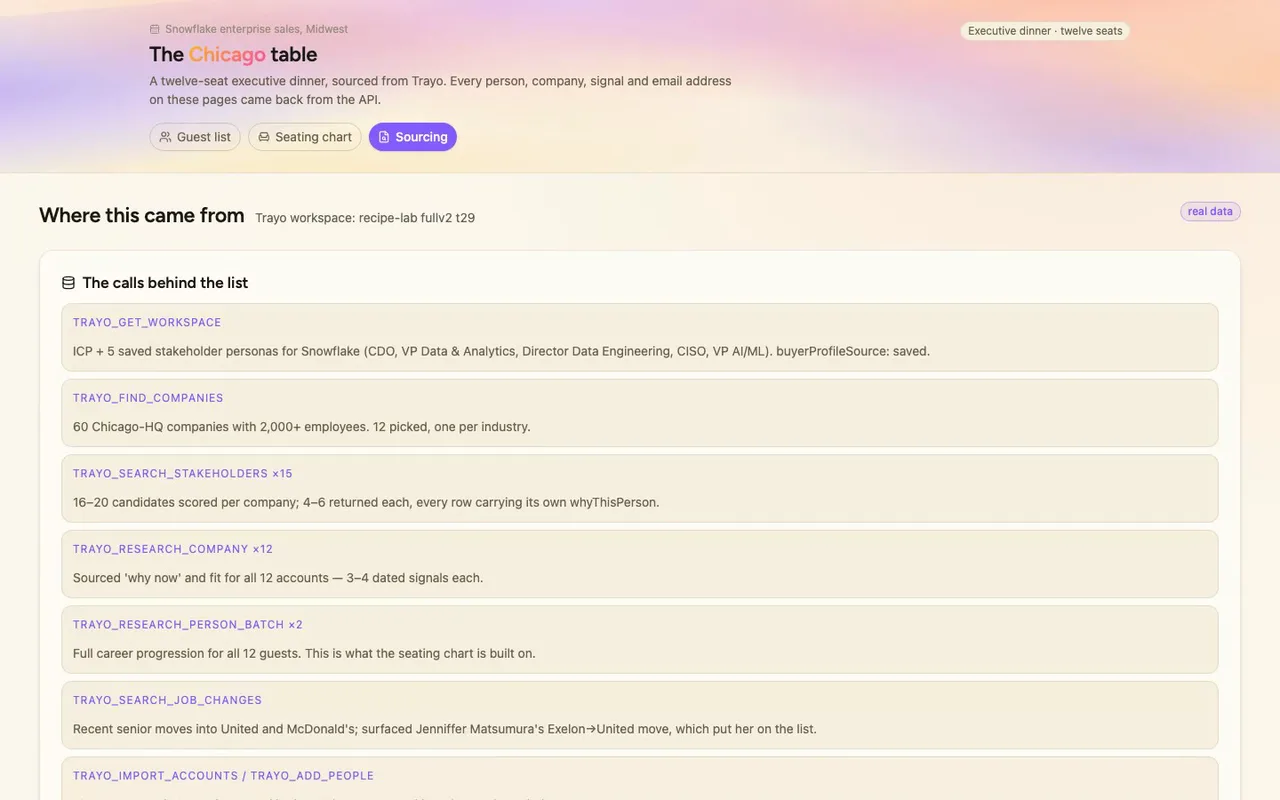
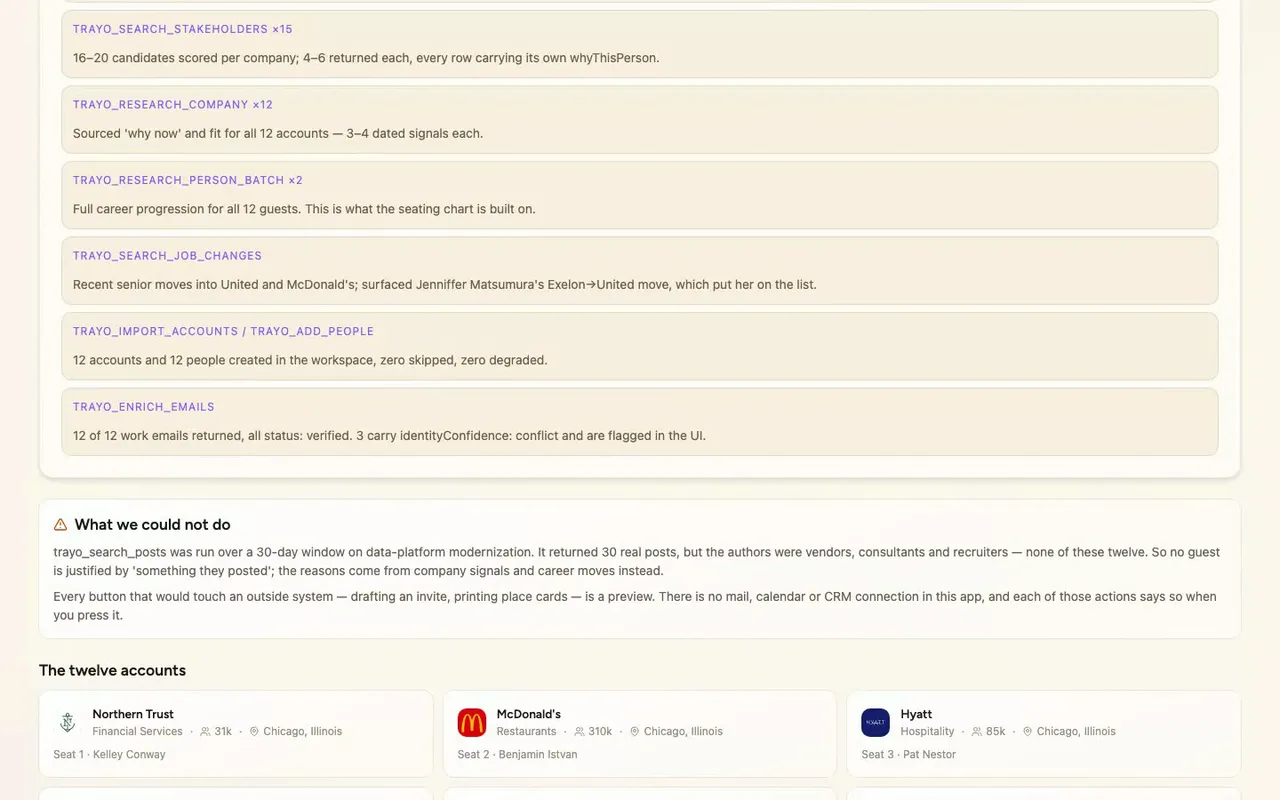
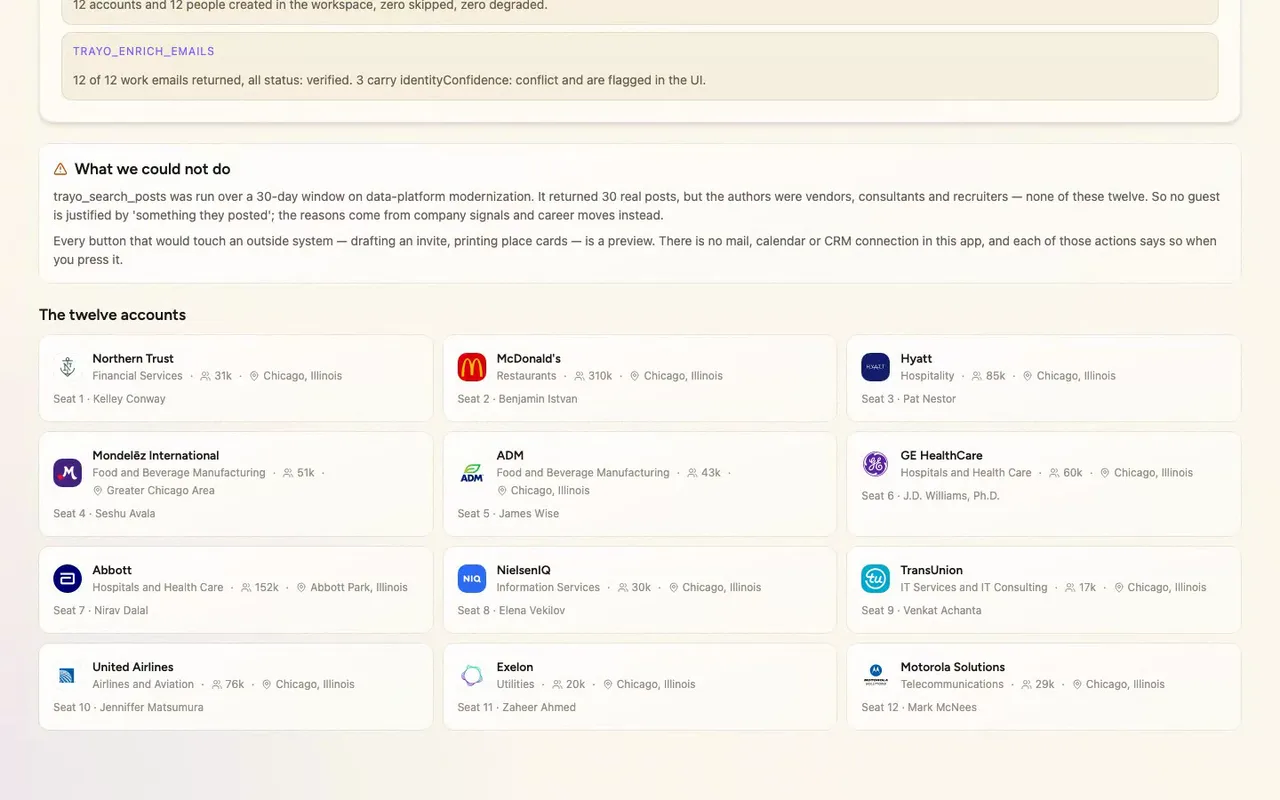
The workspace had no accounts in it, so I took the city and persona from its saved ICP: Snowflake, enterprise, and five stakeholder personas covering CDO, VP Data & Analytics, Director of Data Engineering, CISO and VP AI/ML. I picked Chicago because its Fortune-500 base spans a dozen genuinely different industries. trayo_find_companies returned 60 Chicago-HQ companies over 2,000 employees, and I kept 12, one per industry. trayo_search_stakeholders ran against 15 of them and scored 16 to 20 candidates each, returning 4 to 6 per company with a whyThisPerson line on every row. trayo_research_company gave me three to four dated why-now signals for all 12 accounts, including that Exelon already has Snowflake in its stack and that GE HealthCare has publicly said 97% of hospital data goes unused. trayo_research_person_batch returned full career progressions for all 12 guests, and the seating chart is built on those. Elena Vekilov spent four years as privacy counsel at TransUnion, so she sits next to Venkat Achanta, TransUnion’s CDAO since 2022. Jenniffer Matsumura sits beside Zaheer Ahmed because she was his CIO at Exelon until June. I only found Matsumura’s move because trayo_search_job_changes on United surfaced it, so she reached the list through a signal, not a title search. I then wrote the 12 accounts and 12 people into the workspace with zero skipped and zero degraded rows, and trayo_enrich_emails returned all 12 work emails with status verified.
There are two gaps. The brief asked for guests justified by something they posted. I ran trayo_search_posts over a 30-day window on data-platform modernization and got 30 real posts, but every author was a vendor, consultant or recruiter rather than one of these twelve. No guest is justified that way, and the app says so on the guest list rather than inventing a quote. Also, three of the twelve verified emails came back with identityConfidence: conflict. Trayo confirmed the mailbox exists but could not firmly bind it to the profile, so those three are flagged in the contact dialog instead of shown as clean. The guest data, evidence, seating rationale and emails are all real Trayo output for a real workspace. The two outward-facing actions, Draft the invite and Print place cards, are stubs. There is no mail, calendar or CRM connection here, so each one carries a demo tag and raises a toast naming what would have been sent.