Intent from post authors
A problem-intent board that reads 30 days of public LinkedIn posts for people describing the problem Snowflake solves in their own words, scores each author on ICP fit and how…
- Built in
- 19 min
- Capabilities
- 5
- Live API calls
- 25

The prompt
Paste it into any coding agent with the Trayo MCP connected.
- + any MCP client


Use Trayo to build a problem-intent board from public posts. Let me describe the problem my product solves in my own words, search public posts from the last 30 days for people describing that problem themselves — not complaining about a named competitor, but stating the pain — and pull each author with their title and company.

Score each author on how squarely they sit in my ICP and how explicit the pain is, then roll them up by company. For the strongest 20 people, get a work email and draft one opening line that quotes their own words back to them. Show a feed of the posts with the matched person beside each one, and mark where the post window is thin so I don't read a quiet week as a quiet market.
What this app asked Trayo for
Every name, number and email on the page came back from one of these. None of it was typed in.
- Reads your workspace
What you sell, who you sell to, and the buyer personas already saved in Trayo.
- Finds the right people
Named stakeholders at an account, matched to the buying roles you care about.
- Gets verified emails
Work addresses with a confidence signal, so a bad match is visible rather than sent.
- Builds your account list
Imports, updates and organises accounts so the work survives the session.
- Reads social activity
Posts and the people engaging with them, for plays that start from a conversation.
Take the tour
The same run as the video above, one stop at a time.
- 01
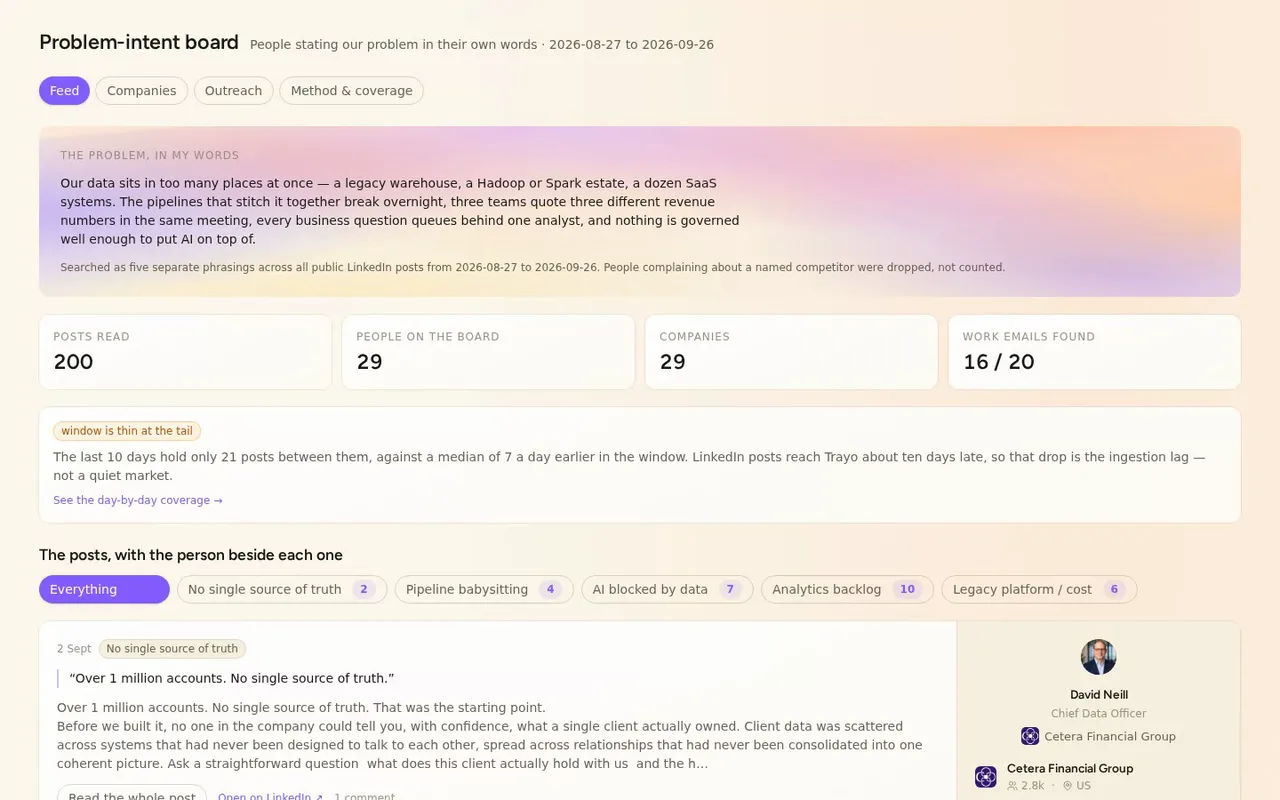
Our reps were searching LinkedIn by hand for people describing scattered data and broken pipelines, then guessing who else to call. So we built a problem-intent board any rep can run on Trayo.
- 02

Every post from the last 30 days sits next to the person who wrote it.
- 03

Five Trayo searches returned 200 posts, and 29 authors survived scoring. Posts about a named competitor were dropped.
- 04
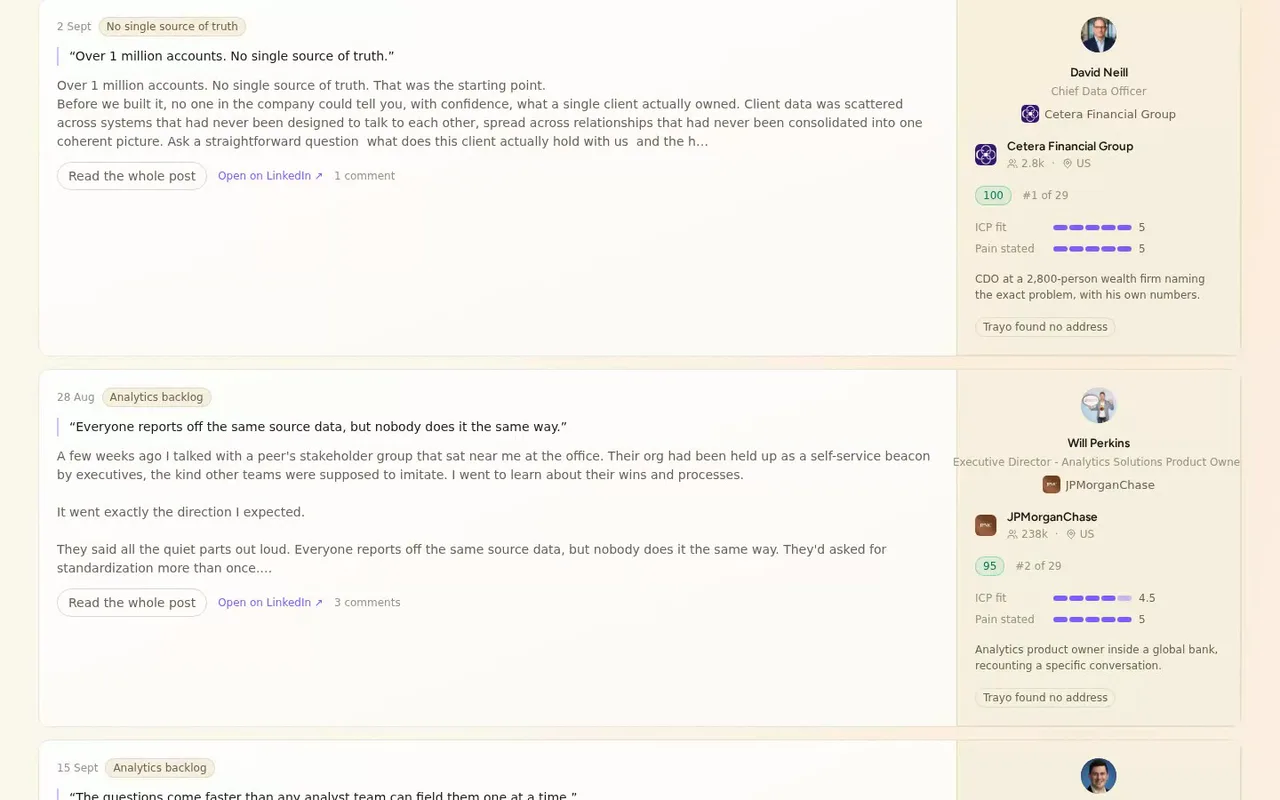
The scores are ours: ICP fit is 55%, pain clarity 45%, judged against the saved buyer profile.
- 05
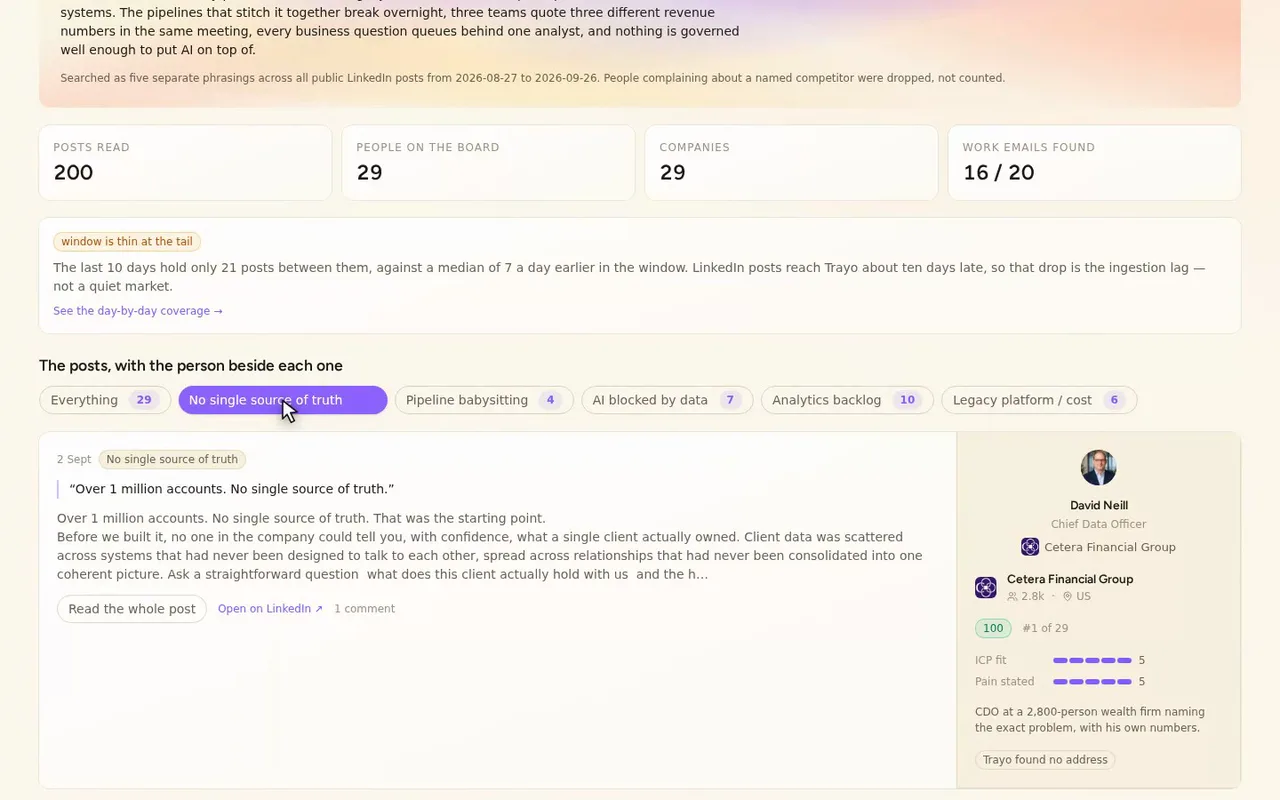
Click a pain like no single source of truth, and you get the people saying it in their own words.
- 06
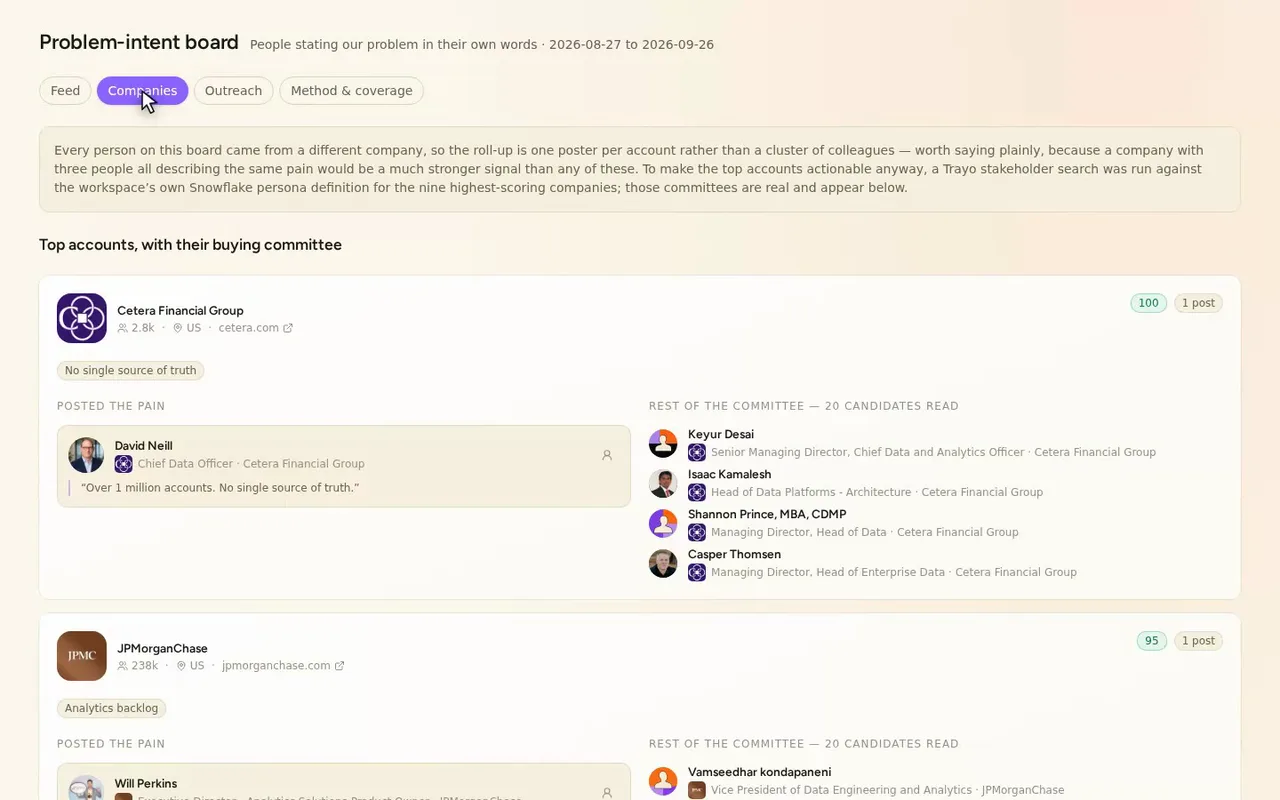
Companies rolls those authors up by account and attaches the rest of the buying committee.
How it was built
The data behind each screen, and what's faked for the demo.
A Snowflake seller who wants to open conversations with people who are already saying, in public, that they have the problem Snowflake solves would use this. They open it on a Monday, when they want to know who wrote about scattered data, overnight pipeline failures or three teams quoting three different revenue numbers in the last 30 days. The Feed shows each post with its author beside it. Companies rolls the authors up into accounts with the rest of the buying committee attached. Outreach lists the 20 strongest people with a work email and a drafted opening line that quotes their own words back to them. Method shows how everyone was scored and what was thrown out.
Without it, this is a manual LinkedIn search across a handful of phrasings. You read posts in one tab, look up each author’s title and company in another, and paste it all into a spreadsheet that is stale by the next week. Then you work out an email lookup and a first line for each person on top of that. Here the posts, the people, the score, the account, the email and the draft sit in one place. Every post that was read and rejected is listed with the reason, so you can check the judgment instead of trusting it.
The workspace already had a saved buyer profile and a saved Snowflake persona definition, so I described the problem in plain words: data spread across a legacy warehouse, a Hadoop or Spark estate and a dozen SaaS systems, pipelines breaking overnight, conflicting revenue numbers, and nothing governed enough to put AI on top of. I searched it five different ways across public LinkedIn posts. Those five searches returned 200 posts for the window 27 Aug to 26 Sep 2026. I dropped every post about a named competitor rather than counting it, because the point was people stating the pain and not complaining about a rival. 29 authors survived my scoring and went into the workspace, which created 29 accounts and filled in 19 real profile photos from Trayo’s own profile mirror. The scores are mine, not Trayo’s: ICP fit is 55% of a 0-100 score and pain clarity is 45%, both judged by reading the posts against the saved buyer profile. I ran the email lookup on the top 20 and got 16 verified addresses back. Four of those carry a caveat, and I flag all four in the UI instead of showing them as clean. Two are addresses where Trayo verified the mailbox but could not confirm it belongs to that person. Two are outright identity conflicts, including a Kenvue lead engineer who resolved to a J&J address, the old parent domain. Then I ran the stakeholder search against the saved persona for the nine highest-scoring accounts. It returned 41 committee members, including the poster alongside the VP or CDO above them at Cetera, DP World and Simmons Bank.
Three things are worth knowing. The email lookup came back empty for the two highest-scoring people on the board, including the CDO who wrote the single best post in the set, so the best lead here can’t be reached by email through Trayo today. All 29 people came from different companies, so the company roll-up is one poster per account and not a cluster of colleagues, which would be a much stronger account signal. The stakeholder search is there to make those accounts actionable anyway. The last ten days of the window hold 21 posts between them, against a median of 7 a day and an average of 8.5 a day across the settled part. That is Trayo’s documented ~10-day ingestion lag and not a quiet market, and the Method page marks it so nobody reads it the wrong way. Sending email is stubbed. The button shows a confirmation and a toast naming the address, tagged as a demo, and nothing leaves the page. Everything else comes from live Trayo calls against a real workspace.