The single-threaded deal alarm
A multithreading risk monitor that scores 12 open accounts against the workspace's own four-role buying committee, marking each seat green, amber or red, and hands back the 20…
- Built in
- 19 min
- Capabilities
- 5
- Live API calls
- 23

The prompt
Paste it into any coding agent with the Trayo MCP connected.
- + any MCP client


Use Trayo to build a multithreading risk monitor. Read my workspace's
stakeholder definition and buyer personas, and for each open account find the
people who fit every role in that committee. Compare them to the people I
already hold in the workspace.
Score each account on coverage: which committee roles are covered, which hang
on a single thread, which are missing entirely. For each gap, give me the named
person, why they matter, and a work email. Present it as a coverage grid —
accounts down the side, committee roles across the top, each cell green, amber
or red — sorted with the most exposed deals at the top, plus a one-click list
of the 20 people who would close the biggest gaps across the whole pipeline.

Known constraints for this build:
the published version scored "people I have actually emailed", which needs a metered `people/{id}/ask` per person and doesn't survive bulk — score held-versus-should-hold instead, and offer the email-history read as a per-account drill-down. One `stakeholders/search` per account is metered and takes 5–20s, so cap the grid at the accounts that matter and refresh on demand.
What this app asked Trayo for
Every name, number and email on the page came back from one of these. None of it was typed in.
- Reads your workspace
What you sell, who you sell to, and the buyer personas already saved in Trayo.
- Finds companies
Surfaces accounts that match your ICP, plus lookalikes of the ones already working.
- Finds the right people
Named stakeholders at an account, matched to the buying roles you care about.
- Gets verified emails
Work addresses with a confidence signal, so a bad match is visible rather than sent.
- Builds your account list
Imports, updates and organises accounts so the work survives the session.
Take the tour
The same run as the video above, one stop at a time.
- 01
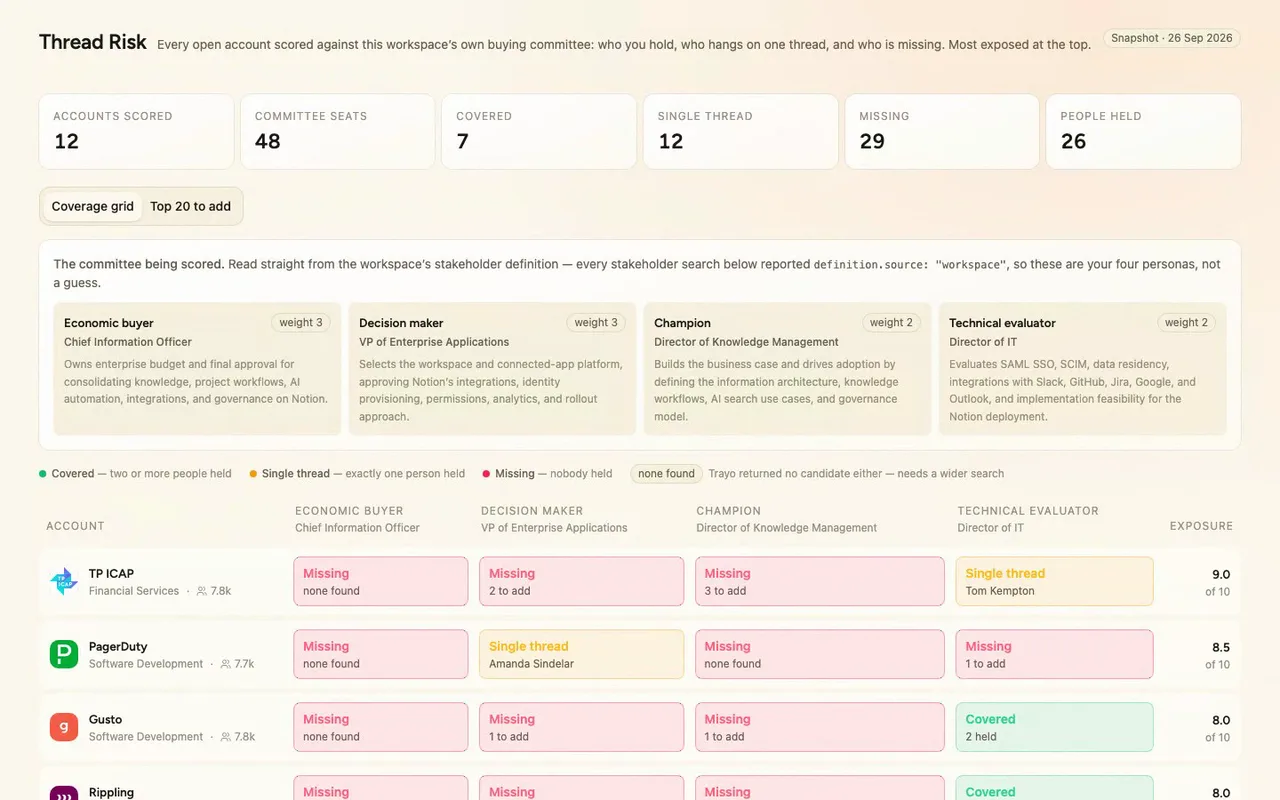
Today we're building Thread Risk, a multithreading monitor for Notion's reps. It scores open accounts against our buying committee and shows which deals hang on one person. Here it is on twelve.
- 02
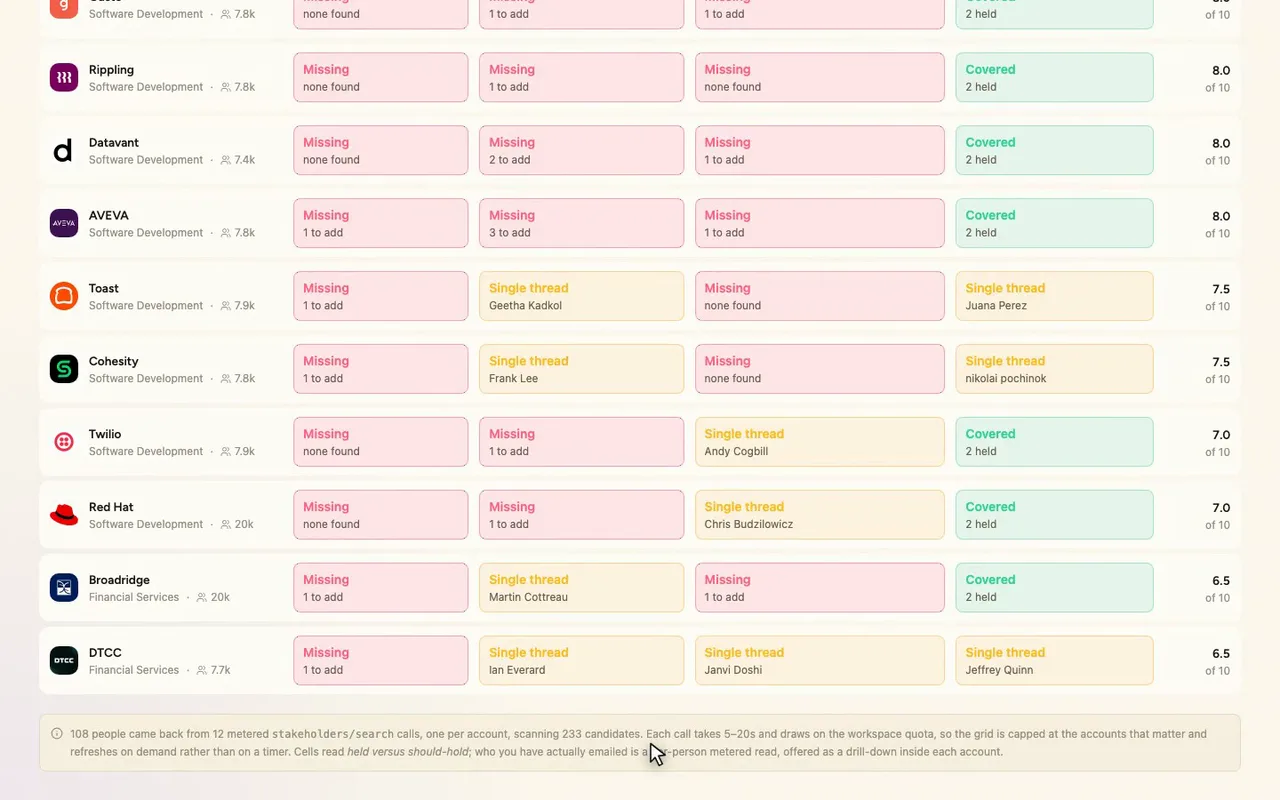
Twelve metered stakeholder searches, five to twenty seconds each, scanned 233 candidates.
- 03
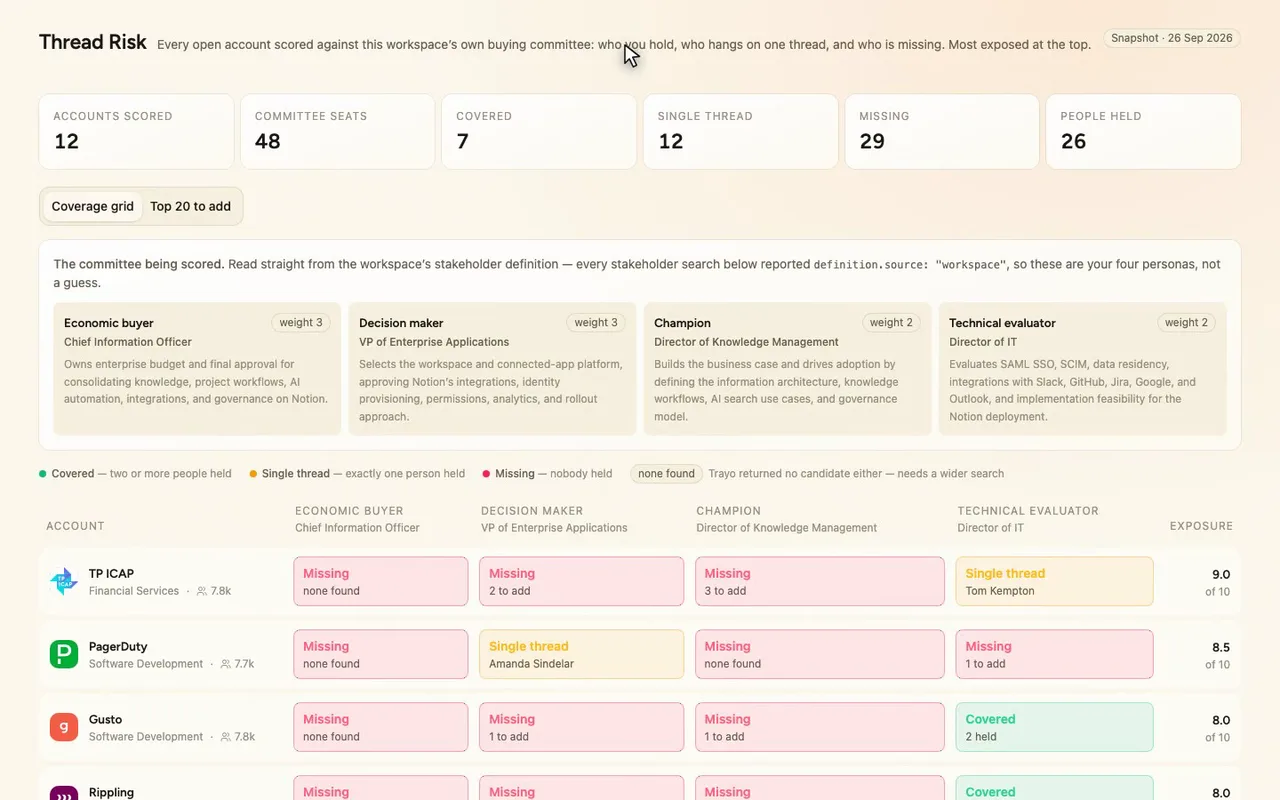
Green is two or more people, amber is one, red is none. A missing economic buyer weighs most.
- 04
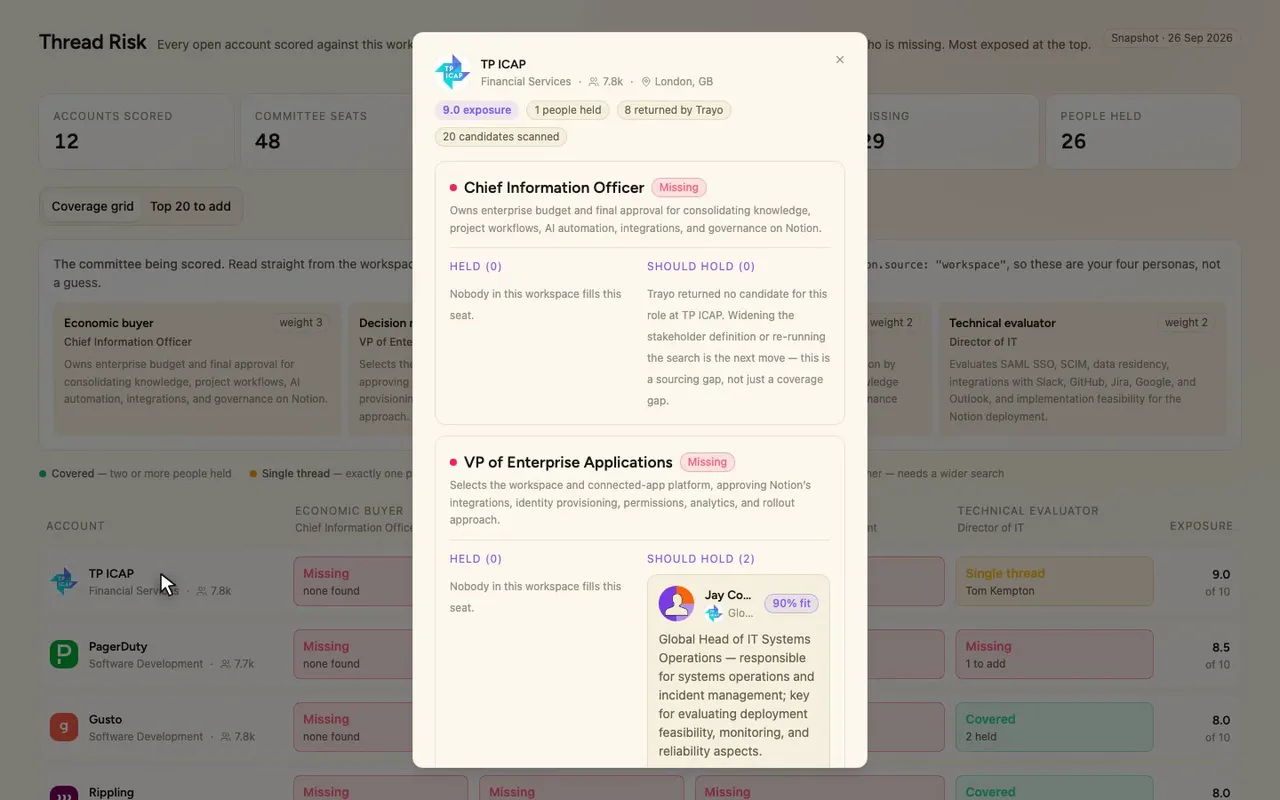
Click an account and it shows who we hold against who we should.
- 05
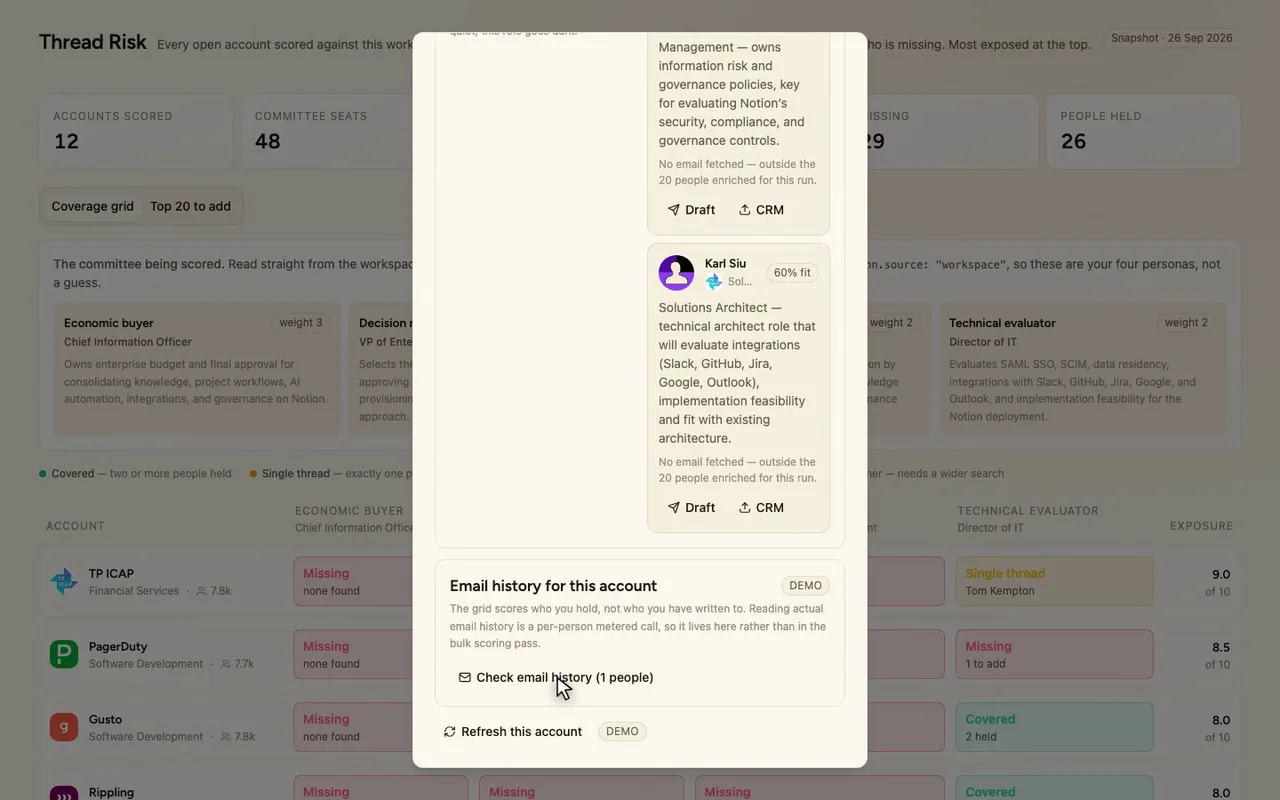
Email history stays a drill-down that states its metered cost and doesn't run.
- 06
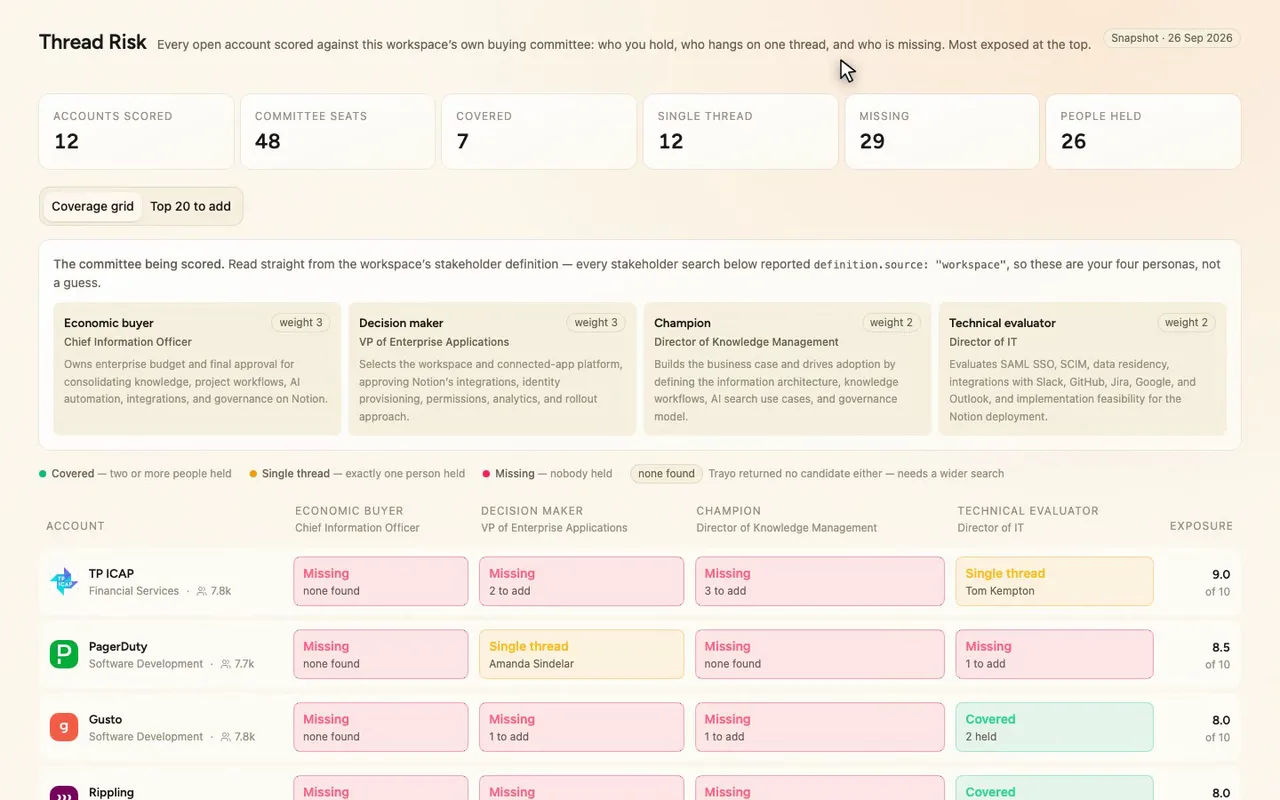
Across 48 seats: seven covered, twelve on one thread, twenty-nine empty.
How it was built
The data behind each screen, and what's faked for the demo.
If you’re a rep with a pile of open deals and a nagging sense that some of them rest on one contact, Thread Risk is for the moment before you forecast or plan the week. It puts 12 open accounts down the side and the workspace’s four buying-committee roles across the top, and colours every cell: green where you hold two or more people in that role, amber where you hold exactly one, red where you hold nobody. The most exposed accounts sit at the top. Click a cell and you see who you hold against who you should, and each candidate for a gap comes with a work email and Trayo’s own reason for why they matter. A second route gives you the 20 people who would close the most exposure across the whole pipeline.
What it replaces is the manual version of this: opening each account, remembering or guessing who is on the committee, checking a CRM or spreadsheet for who you already know, then searching LinkedIn and an email finder for the rest. That check is usually done once and goes stale. Here the committee comes from the workspace’s own stakeholder definition, so the roles are the ones you already defined, and the ranking is weighted so a missing economic buyer costs more than a missing technical evaluator. The shortlist is one name per gap, so twenty picks land on twenty different holes rather than five names at the same account.
The workspace was empty, so I found accounts first, using POST /v1/find against the saved Notion ICP, and imported them with trayo_import_accounts. Then I ran one trayo_search_stakeholders call per account, 12 in all. Each is metered and takes 5 to 20 seconds. Together they scanned 233 candidates and returned 108 people, and every response reported definition.source: “workspace”, so the committee being scored is the workspace’s own and not one I made up. The workspace also held no people, so I seeded 26 held relationships with trayo_add_people from those real search results, and took the coverage snapshot at that moment before any scoring ran. Of 48 committee seats, 7 are covered, 12 hang on one thread and 29 are empty. In 11 of those 29, Trayo returned no candidate for the role at all, and the grid calls those out separately as a sourcing problem rather than an outreach one. I then ran trayo_enrich_emails on the 20 shortlisted people and got a verified work address for all 20. Eighteen came back identityConfidence: “match” and 2 came back “conflict”, both people whose LinkedIn profile carries an abbreviated surname. The UI labels those two instead of presenting them as clean.
Some of this is stubbed, and you should know which. The comparison is genuine, but the starting hand is a choice I made: the 26 held relationships are seeded from search results, not your actual book. I left out scoring on who you have actually emailed. That needs a metered people/{id}/ask call per person and does not survive 108 people, so the grid scores held versus should-hold, and each account offers the email-history read as a drill-down that states its cost and does not run. Refresh, push to CRM, draft and send are buttons that show a confirmation toast and a “demo” tag. No Salesforce, HubSpot, Slack or mail integration is connected, and nothing was sent.