Intent hiding in the comments
A demand-pool app that turns commenters on public LinkedIn posts into ICP-scored companies, with a bubble view that opens each company's real comments beside the people to write…
- Built in
- 21 min
- Capabilities
- 2
- Live API calls
- 11

The prompt
Paste it into any coding agent with the Trayo MCP connected.
- + any MCP client


Use Trayo to build a demand-pool app out of public post conversations. Let me
type a topic — "data migration pain", "SOC 2 audit hell", "replacing our CDP" —
search public posts from the last 30 days on it, then pull every commenter on
the strongest posts with their title and company.
Roll the commenters up by company, score each company on how many of its people
engaged and how senior they were, and drop the ones outside my ICP. For the top
20 companies, add the account, map the buying committee and get work emails.
Show me a bubble view of companies sized by engagement volume; clicking one
opens the actual comments its people left, next to the people I should write
to. Note where post coverage is incomplete so I don't read a thin week as a
quiet market.

Known constraints for this build:
posts arrive ~10 days late and the window caps at 30 days, so the most recent days are always thin — say so in the UI. `posts/search` is in the 7-requests-a-minute heavy bucket. Commenters carry a company only where Trayo knows them; show the unmatched count rather than silently dropping it.
What this app asked Trayo for
Every name, number and email on the page came back from one of these. None of it was typed in.
- Reads your workspace
What you sell, who you sell to, and the buyer personas already saved in Trayo.
- Reads social activity
Posts and the people engaging with them, for plays that start from a conversation.
Take the tour
The same run as the video above, one stop at a time.
- 01
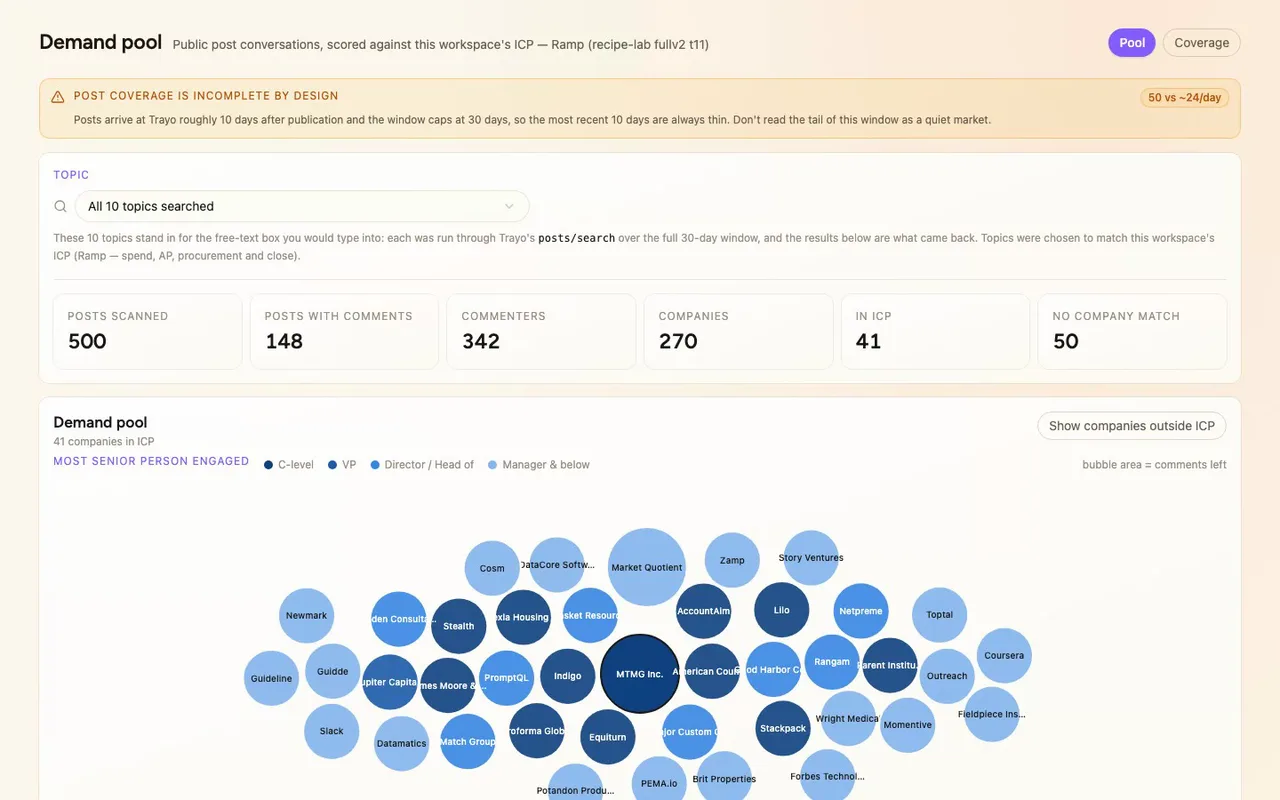
Our reps were pulling commenters off public LinkedIn posts by hand, then guessing which companies mattered. So we built a demand-pool app on Trayo: pick any topic, get ICP-scored companies, the real comments, and who to write to.
- 02
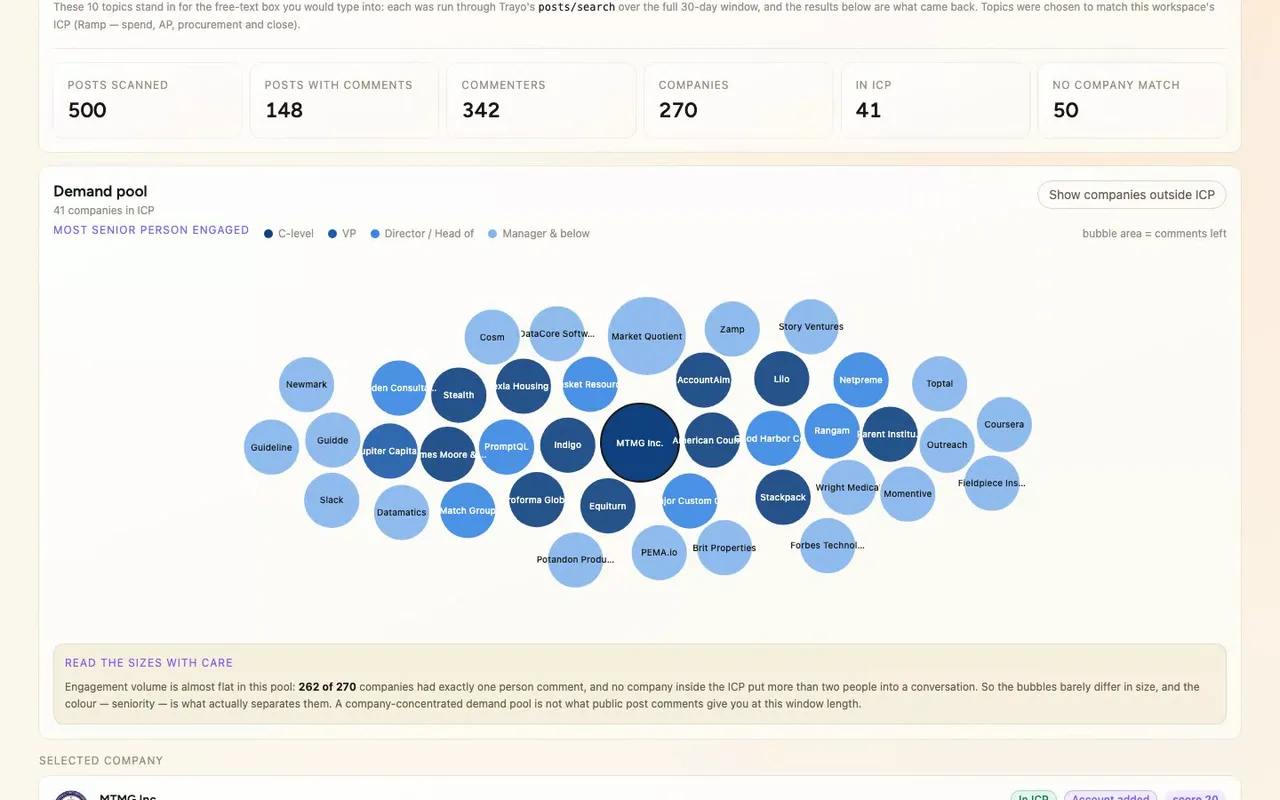
Ten post searches over the last 30 days returned 500 posts. 148 had comments, and those gave 342 commenters across 270 companies.
- 03
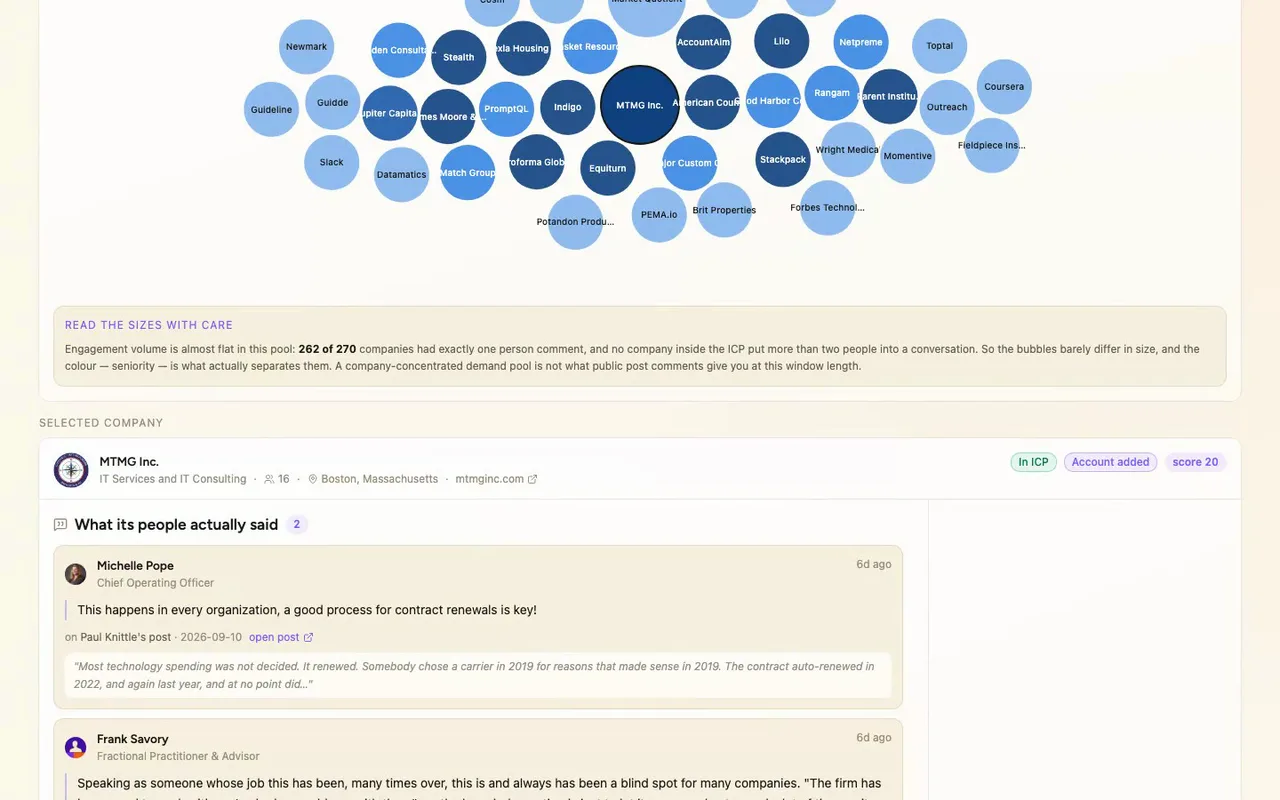
A Trayo find call supplied headcount, HQ and industry, leaving 41 companies inside Ramp's ICP: US-headquartered, 10 to 10,000 employees, not a competitor.
- 04
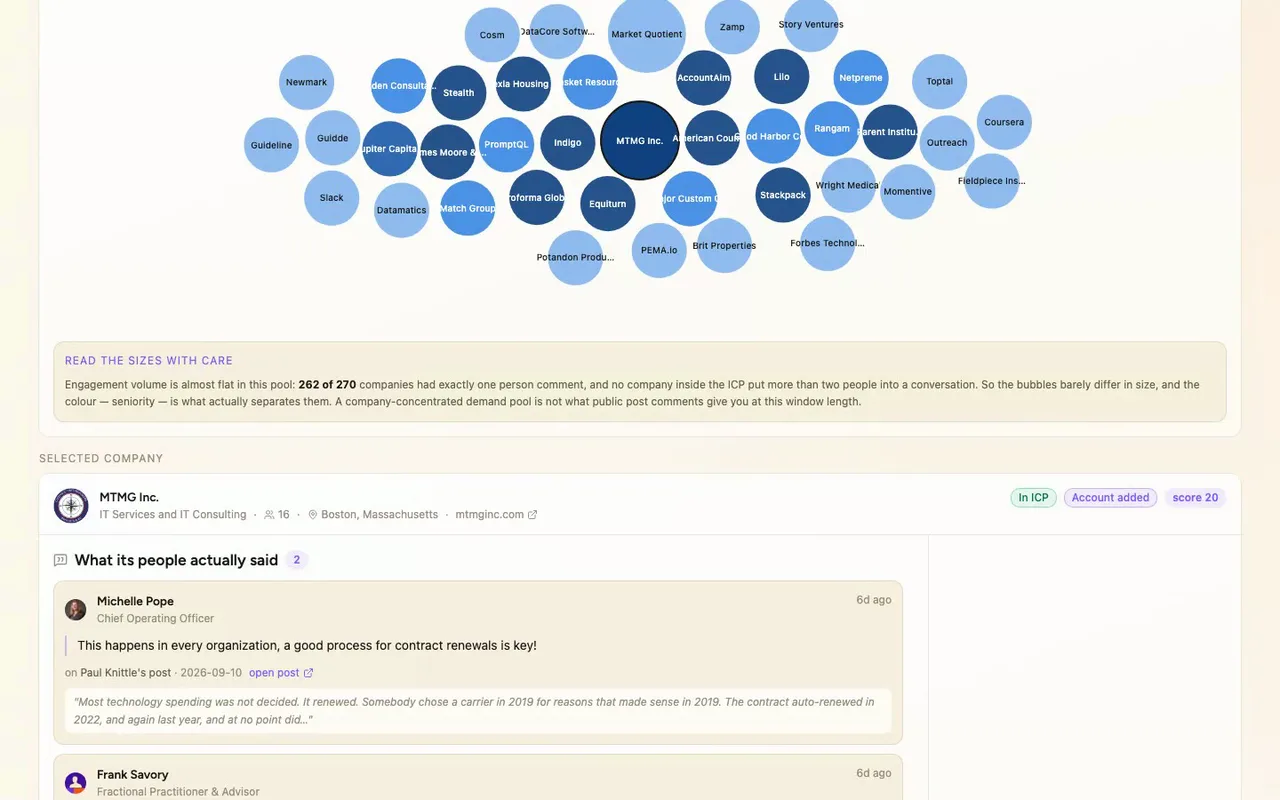
Bubbles are sized by engagement and coloured by seniority. They barely differ in size, since 262 of 270 companies had one commenter, and the page says so.
- 05
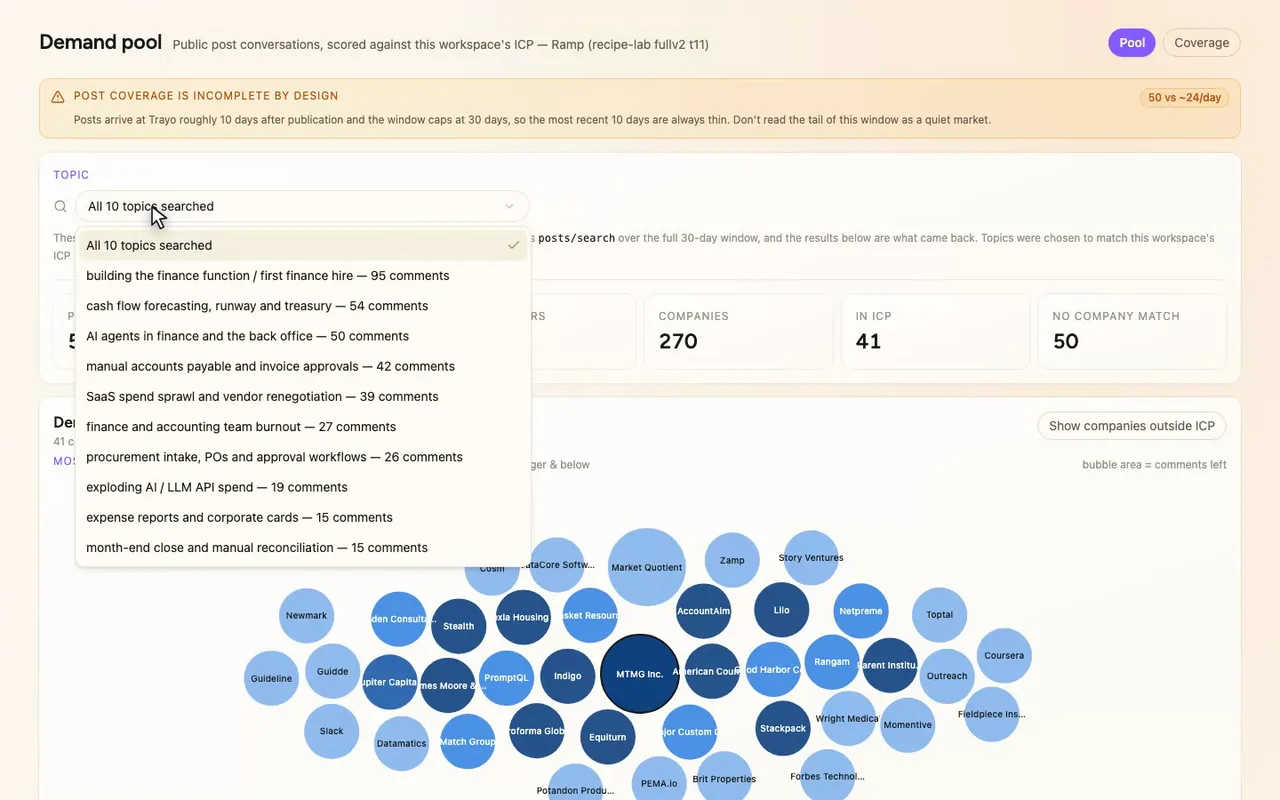
Here are all ten topics searched, so you can see exactly what the pool was built from.
- 06
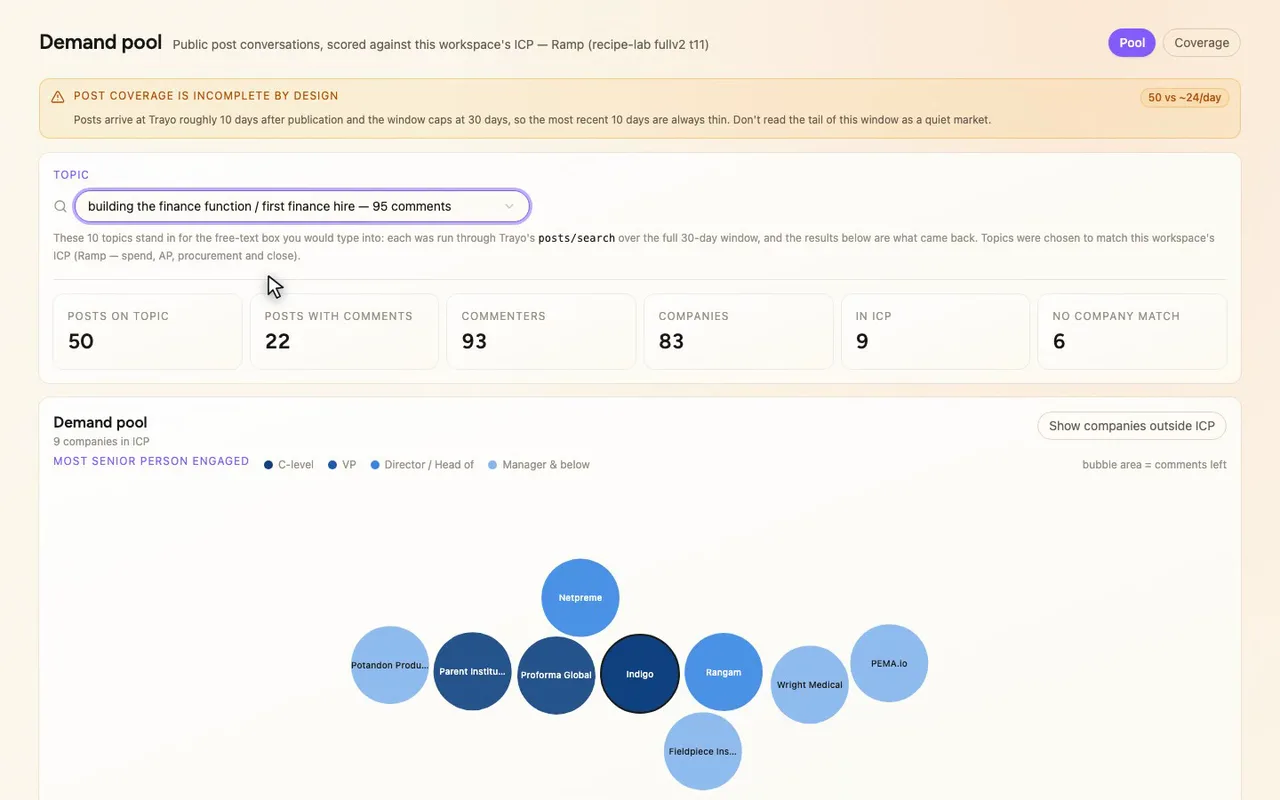
Pick a topic, like building the finance function, and the pool narrows to it.
How it was built
The data behind each screen, and what's faked for the demo.
If you’re a rep selling Ramp and you want to know who is talking about a problem you solve, you type a topic like “data migration pain” or “SOC 2 audit hell” and get a bubble view of companies whose people commented on public LinkedIn posts about it in the last 30 days. Bubbles are sized by how much each company engaged and coloured by how senior its most senior commenter was. Click one and you see the comments its people actually left, with the buying committee to write to and their work emails beside them. Anything outside your ICP is dropped but stays visible with the reason, so you can see who was in the room and why they went.
It replaces the loop of searching posts by hand, opening each comment thread, working out who commenters work for, checking whether the company fits, and then looking up the right people separately. That usually ends up in a spreadsheet that is stale by the time you use it. Here the topic goes in and a ranked, contactable list comes out. It also says where the data is thin: posts arrive about 10 days late and the window caps at 30 days, so the most recent days are always sparse, and the UI tells you that so a quiet week isn’t read as a quiet market.
Everything on the page came from the Trayo API, against a real Trayo workspace with Ramp’s ICP already saved in it. Ten posts/search calls over the full 30-day window returned 500 posts. That endpoint sits in the heavy bucket of 7 requests a minute, so I kept the number of calls small. 148 of the posts had comments, and posts/engagers on each returned 342 commenters across 270 companies. POST /v1/find with companyIds supplied headcount, HQ and industry, and I used those to filter to Ramp’s ICP of US-headquartered, 10–10,000 employees, not a competitor. That left 41 companies. I put the top 20 in as accounts through accounts/batch, and stakeholders/search mapped 39 buying-committee people against the workspace’s own Ramp personas. people/enrich/batch returned work emails for 45 of the 54 people added. One real example: Indigo’s Global CFO commenting on how to build a finance operating model, with five reachable addresses on that account.
Three limits are worth stating. The pool isn’t concentrated: 262 of the 270 companies had exactly one person comment, and no company inside the ICP put more than two people into a conversation. The bubbles barely differ in size, so seniority is what actually ranks them, and the page says so instead of hiding it behind the chart. Trayo returns a company only for people it already knows, and 50 of the 342 commenters came back without one, so I count them in their own section rather than dropping them. stakeholders/search found nobody matching the Ramp personas at 7 of the 20 accounts, and 9 of the 54 people have no email.
The data is real, but the actions are not. The Salesforce, outreach and Slack buttons are stubs. They are tagged “demo” and raise a toast saying what would have been sent, because no such integration is connected in this build.