Social listening
A radar board of 13 real LinkedIn posts where practitioners complain about Wiz's competitors, each with the quote, the competitor named, a suggested opener, the people who replied…
- Built in
- 10 min
- Capabilities
- 3
- Live API calls
- 20

The prompt
Paste it into any coding agent with the Trayo MCP connected.
- + any MCP client


Use Trayo to find posts where people express frustration with my competitors, then show me the results in the web app.
What this app asked Trayo for
Every name, number and email on the page came back from one of these. None of it was typed in.
- Reads your workspace
What you sell, who you sell to, and the buyer personas already saved in Trayo.
- Researches an account
A live snapshot per company — size, stack, why-now signals and why it fits.
- Reads social activity
Posts and the people engaging with them, for plays that start from a conversation.
Take the tour
The same run as the video above, one stop at a time.
- 01
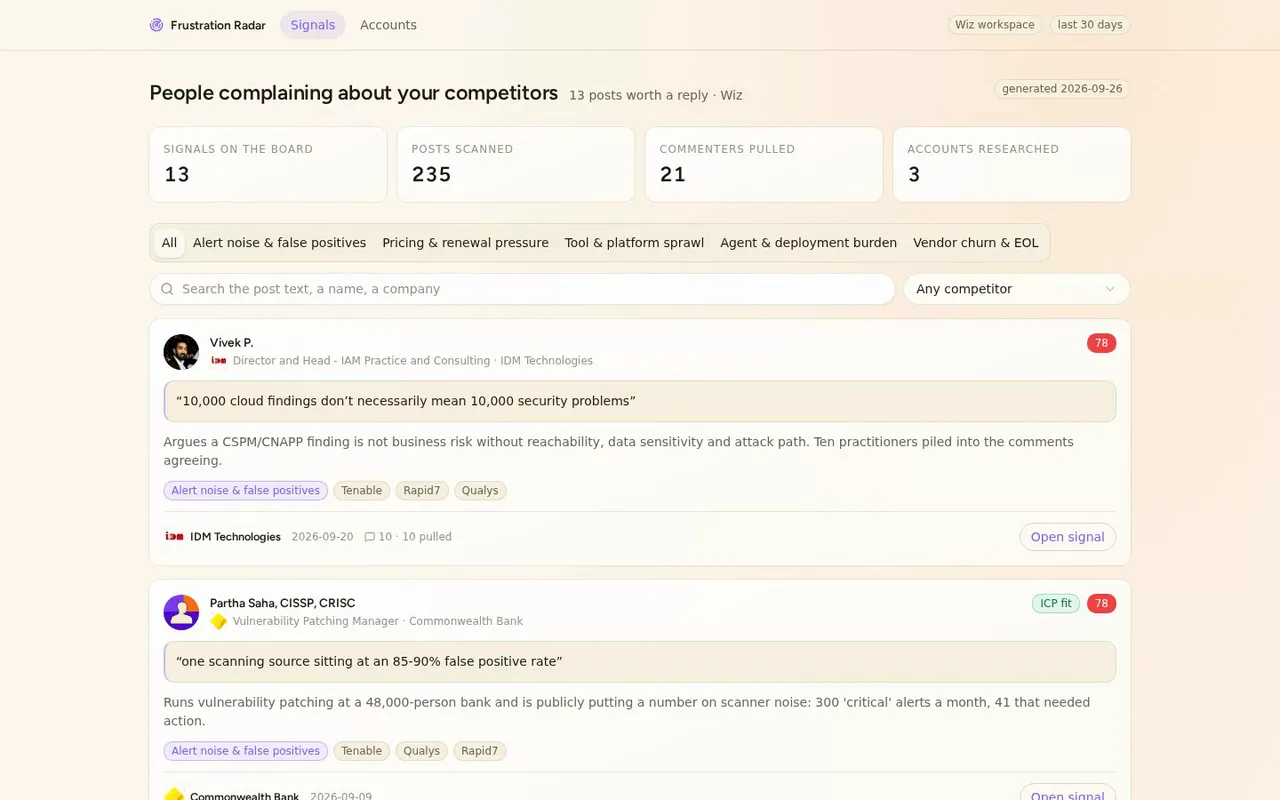
Our reps were hunting LinkedIn by hand for people complaining about competing cloud-security products, and most of it never got seen. Frustration Radar is one board for any Wiz account executive, with real posts, the quote, and an opener.
- 02
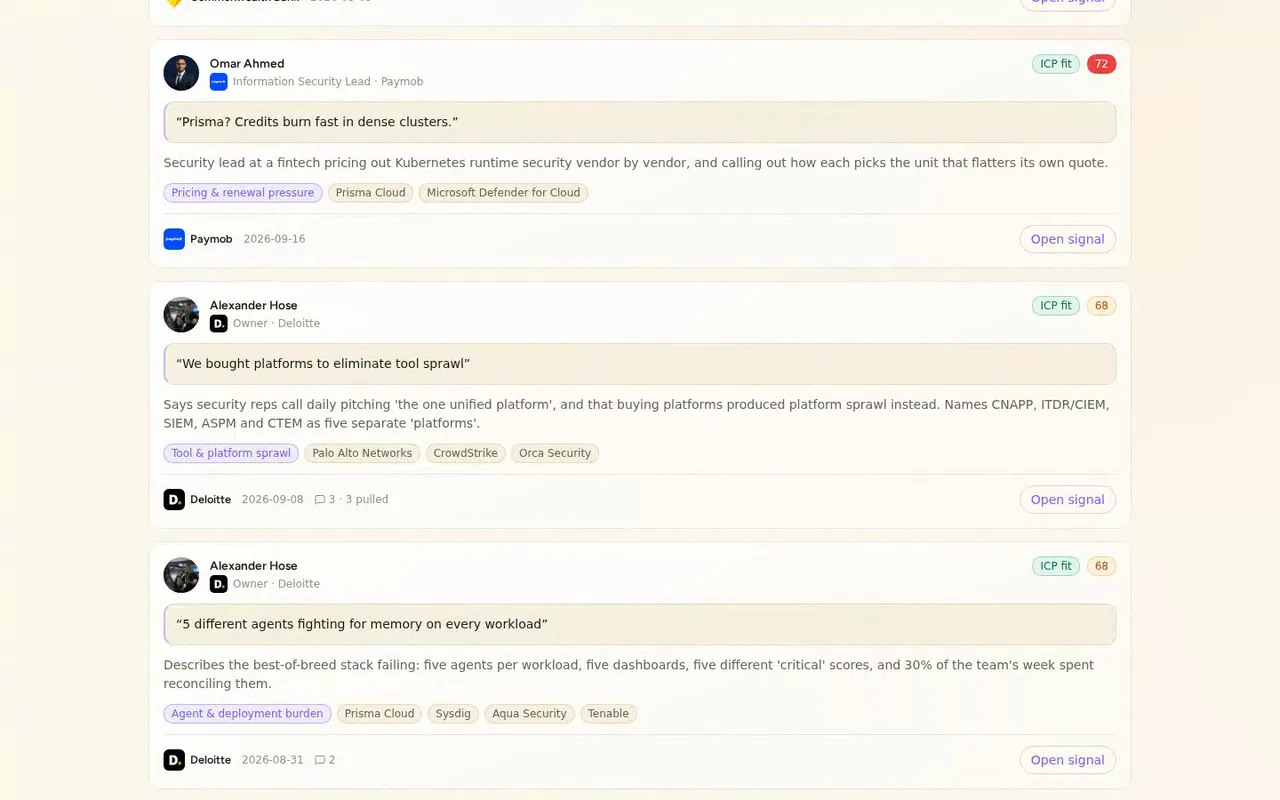
Thirteen posts from the last 30 days, each with the verbatim quote and the competitor it names.
- 03
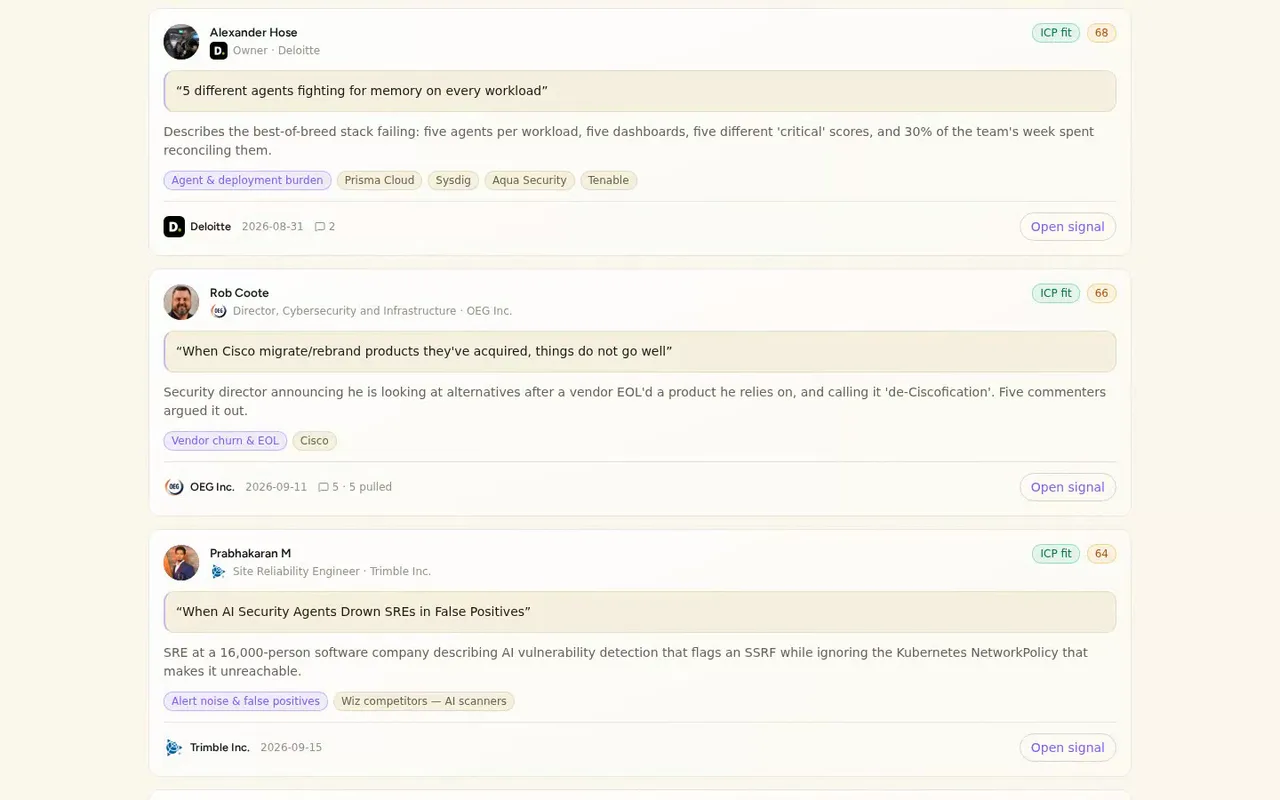
Prisma credits burning through a dense Kubernetes cluster, five agents fighting for memory on one workload. That's the frustration.
- 04
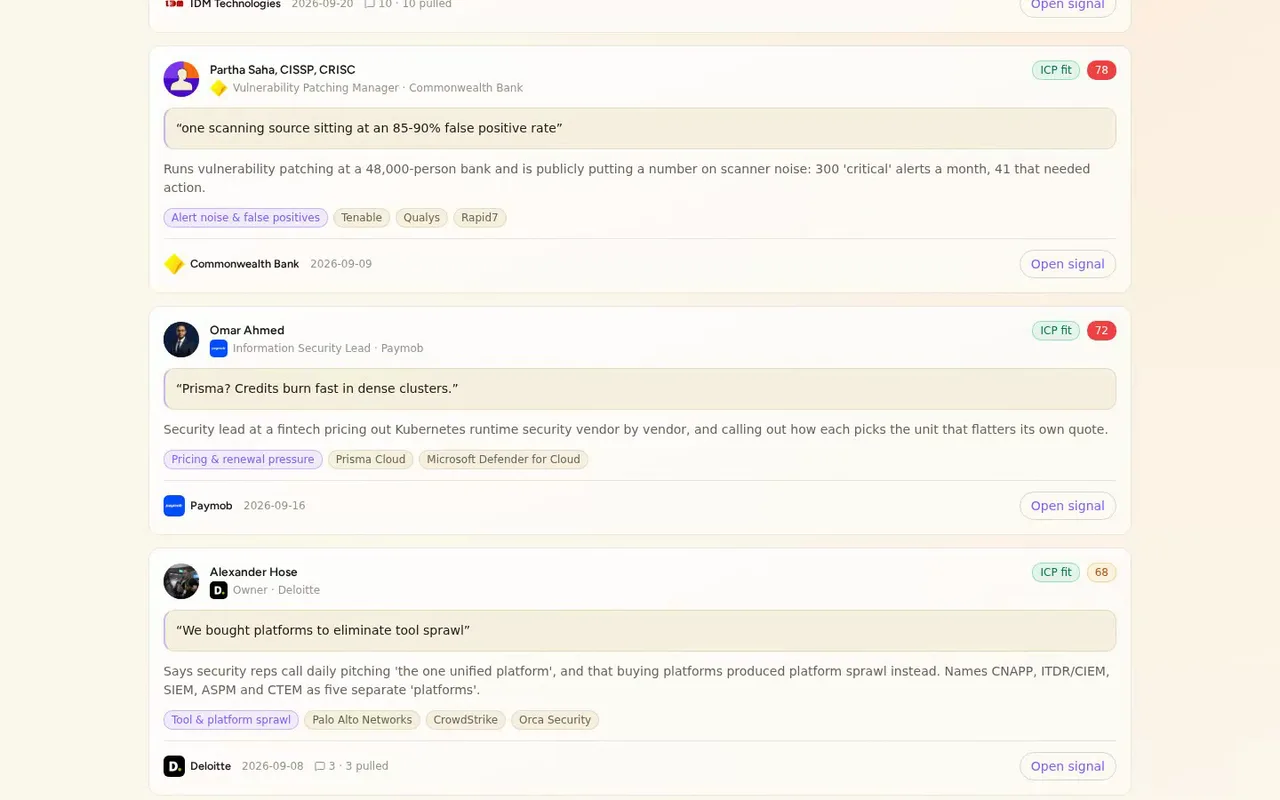
Every card says why it's worth a reply and suggests an opener. Those scores and openers are the app's own editorial, labeled that way.
- 05
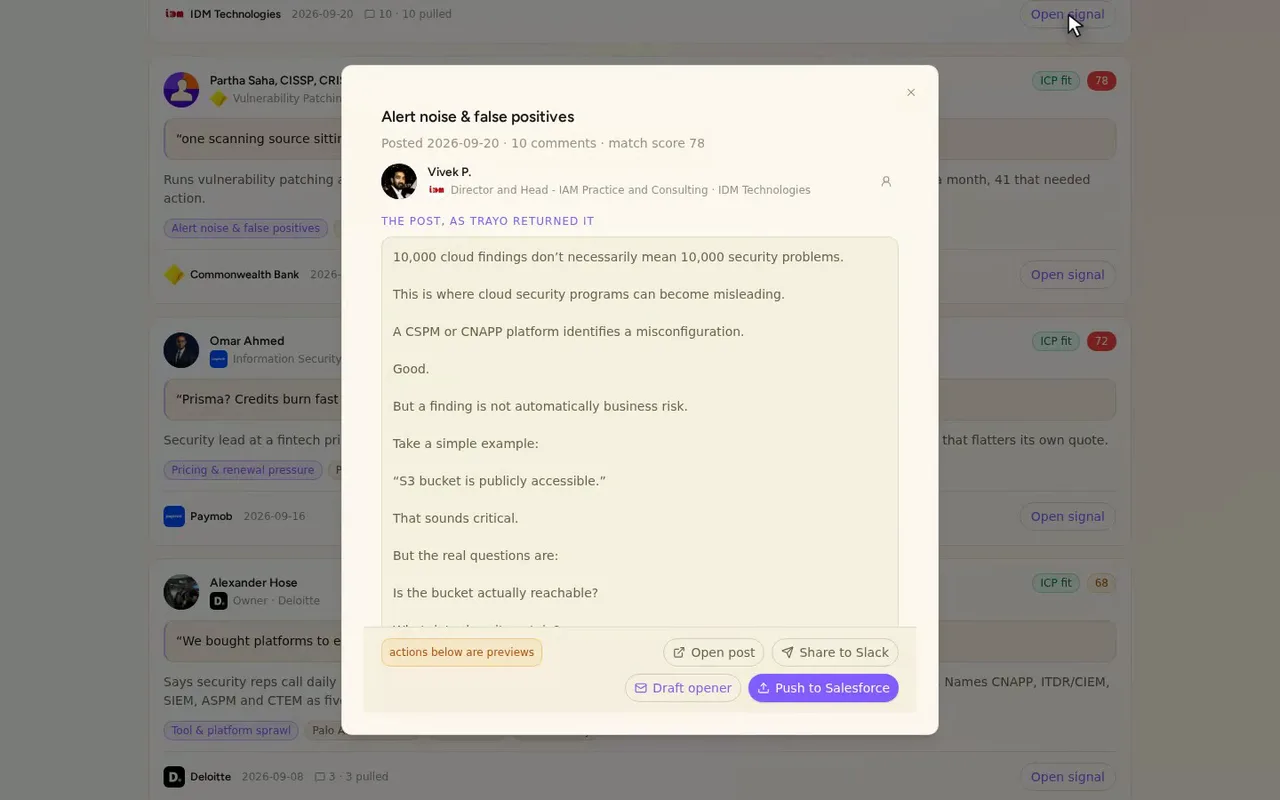
Open a card and you get the full post as Trayo returned it, plus the queries that found it.
- 06
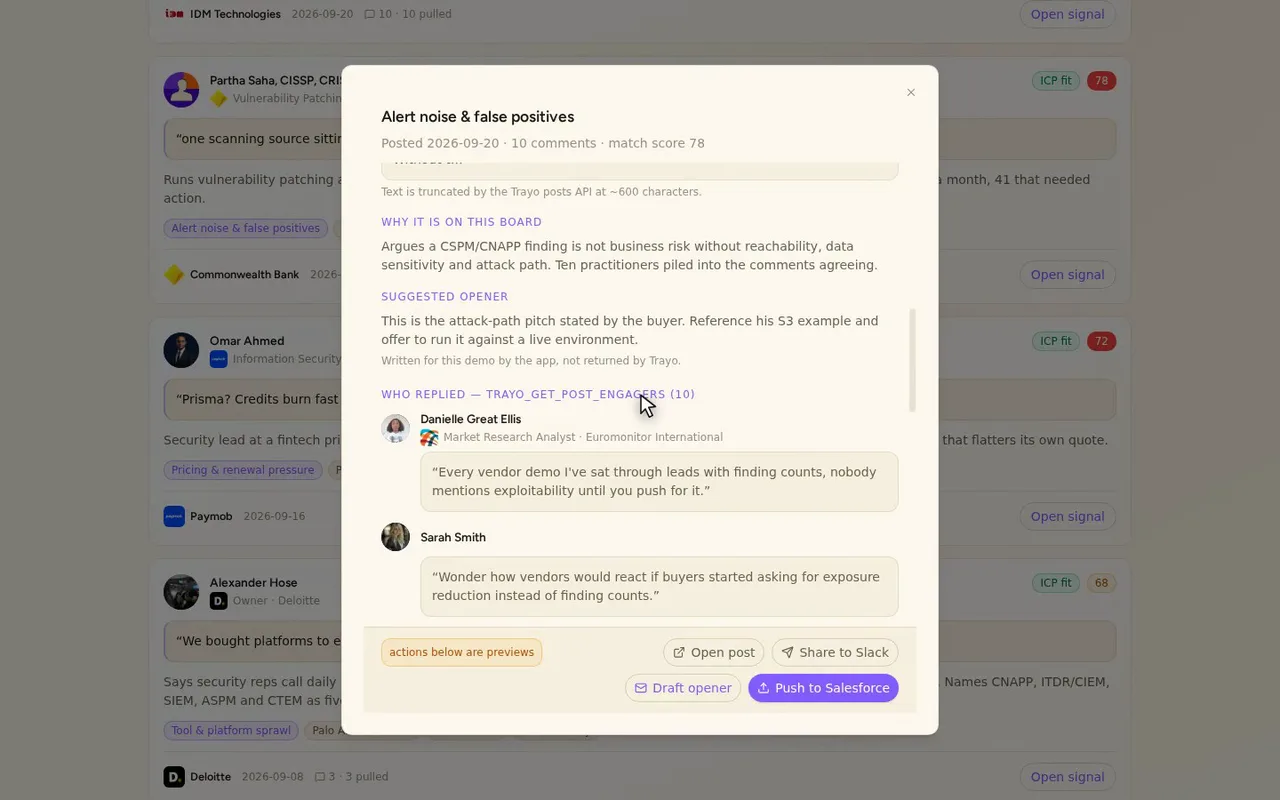
Here's who replied. Trayo's engager call pulled the commenters with their text, like the ten practitioners arguing under Vivek P.'s post.
How it was built
The data behind each screen, and what's faked for the demo.
Frustration Radar is for a Wiz account executive who wants a reason to message someone this morning. They open one screen and see 13 LinkedIn posts from the last 30 days where a practitioner is publicly unhappy with a competing cloud-security product: alert noise from a scanner, five agents fighting for memory on one workload, Prisma credits burning through a dense Kubernetes cluster, a platform being given away free for a year. Each card has the verbatim quote, the competitors it names, why it is worth a reply, and a suggested opener. Opening a card shows the full post as Trayo returned it, the people who commented, and the queries that found it. A second route holds account briefs for the three companies behind the loudest signals.
It replaces the loop of searching LinkedIn by hand for competitor names, scrolling through noise, and pasting the good ones into a spreadsheet that is stale by the next week. The search already ran, and the ten practitioners arguing under Vivek P.’s “10,000 cloud findings” post are sitting next to the post, so there is no second tab to open to see who is engaged. The account briefs mean a rep does not have to research Commonwealth Bank, Trimble or Logitech before deciding whether to reply.
Everything on the board came from Trayo. I started with trayo_get_workspace, because the workspace sells Wiz and its ICP decided who counts as a competitor and who counts as a buyer. That gave me the watch list: Prisma Cloud, CrowdStrike Falcon Cloud Security, Orca, Sysdig, Tenable and Microsoft Defender for Cloud. Seven trayo_search_posts calls over a 30-day window returned 235 distinct posts. Most of them were not frustration. There were competitors’ own sales reps celebrating analyst reports, Palo Alto training certificates, and backend developers complaining about database migrations, because “Prisma” is also a Node.js ORM. I dropped vendor employees and anyone selling the same category by hand, which is how 235 became 13. Then I ran four trayo_get_post_engagers calls, which pulled 21 commenters with their comment text, and three trayo_research_company calls, which produced the why-now and fit bullets for Commonwealth Bank, Trimble and Logitech. I left those bullets unedited. I also ran trayo_whoami at the start to confirm which workspace I was in.
The posts, commenters and briefs are real Trayo data, and nothing was written back to the workspace. Two things to know. The posts API truncates text at about 600 characters, so some quotes end mid-thought. And for one author, Alexander Hose, the post search reported Deloitte as his company while the engagers call reported Cloud Security Index, so the card shows what the post search returned. The scores and suggested openers are my own editorial, computed locally and labelled that way in the UI. Every button that would touch a system we are not connected to (Salesforce, HubSpot, Slack, email) is a stub. It fires a toast saying what would have been sent and carries a “demo” tag, because none of those integrations are wired up.